
Choosing Your Fly Fishing Sunglasses

800 • 669 • 3474

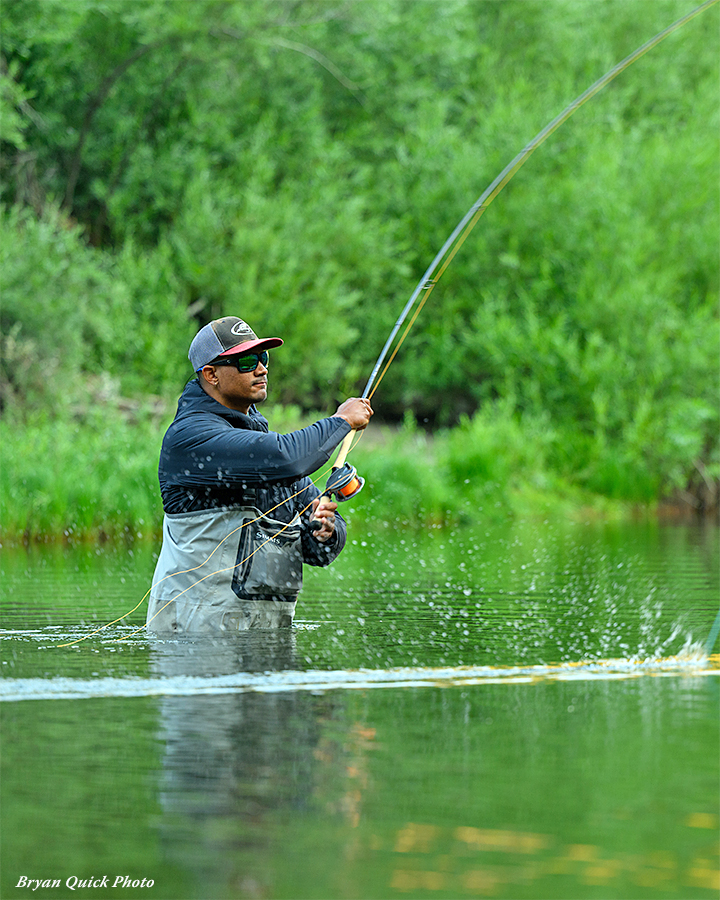
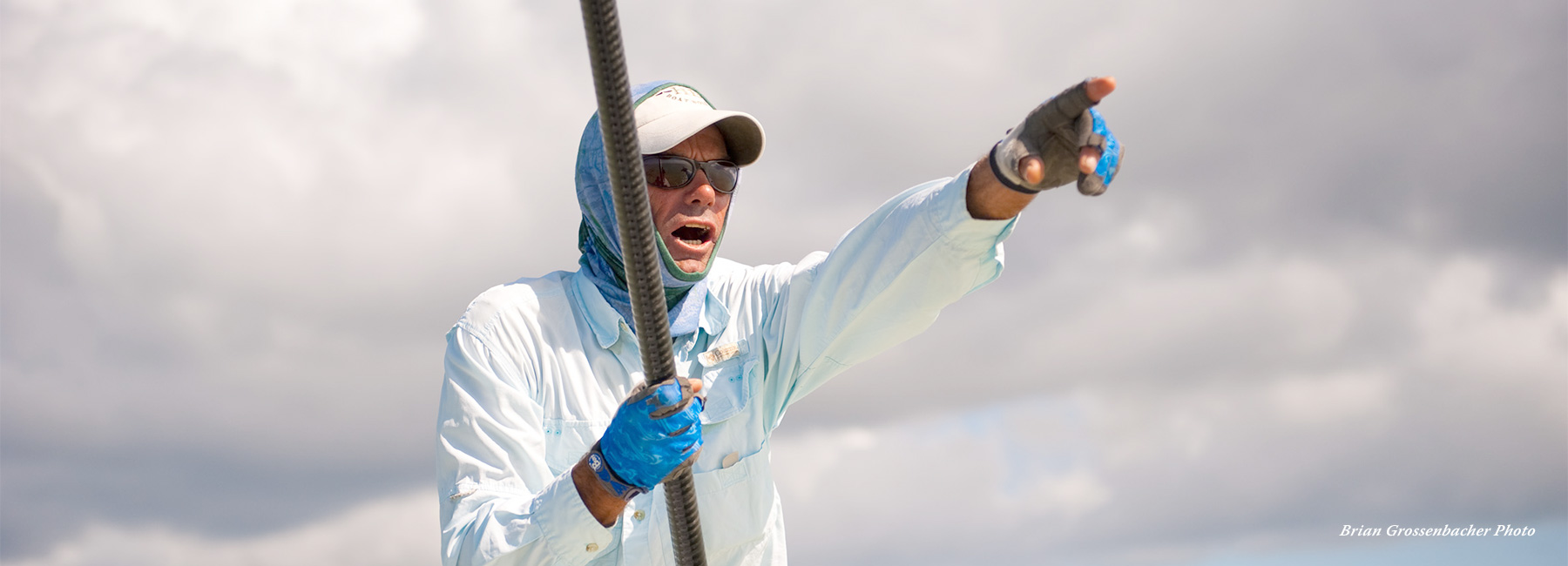
Sunglass selection can be a touchy subject for many, as sunglasses are such a personal choice.  We aren’t going to tell you what style, brand or model to buy, but rather give some insight and suggestions on lens color and functionality.

One of the most important pieces of equipment for any fly fisherman is their sunglasses. One of the few risks involved in fly fishing is getting a wayward hook into the eye. Wearing sunglasses whenever fishing, or even casting on the lawn, will help mitigate a serious eye injury.

Sunglasses will also protect your eyes from harmful rays from the sun. The best sunglasses for fishing feature polarized lenses. Polarized lenses are treated with a chemical that filters out light. The filter is applied vertically, so vertical light can pass through, but horizontal light cannot. The lenses block all the horizontal light waves bouncing off the surface of the water allowing you to see under the surface. It’s weird science, but it works!

Chart showing how polarization works on sunglasses

Additionally, polarization helps you not only spot fish, but also allows you to see underwater hazards like a rock ledge, stump, boulder or hole. Polarized lenses can come in a variety of different shades and colors.  If you are going to have one set of fishing shades, lenses in brown, amber, or copper will cover the broadest range of light situations. Other options include yellow and gray; yellow lenses are best for low-light situations, while gray lenses are the best for seeing true colors which can be especially useful in blue water fishing.

“I’d rather forget my fly rod on a trip than my sunglasses” – Mel Kreiger

Lens Color

Lens Options:
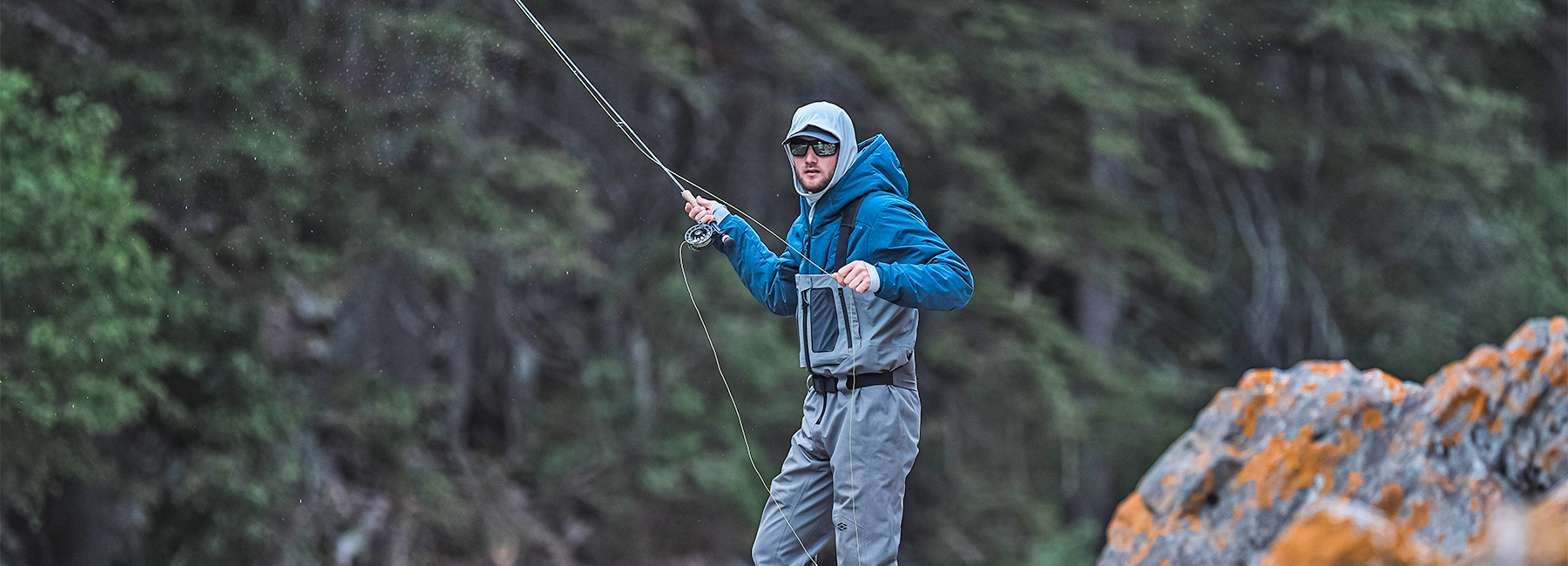
“Whether you’re traveling across the country or to the local river, it never feels good to get to the ramp and realize you have the wrong gear. I’ve been wearing a mixture of green mirror and the sunrise silver (yellow) mirrored lenses depending on the light conditions. I recently received a pair of Costa’s new Rose Gold lenses to give me more versatility in any light condition, and look forward to putting them to the test. Here’s a breakdown of how I’ve used my lenses, and the different options available for your next pair!”Jordan Taylor

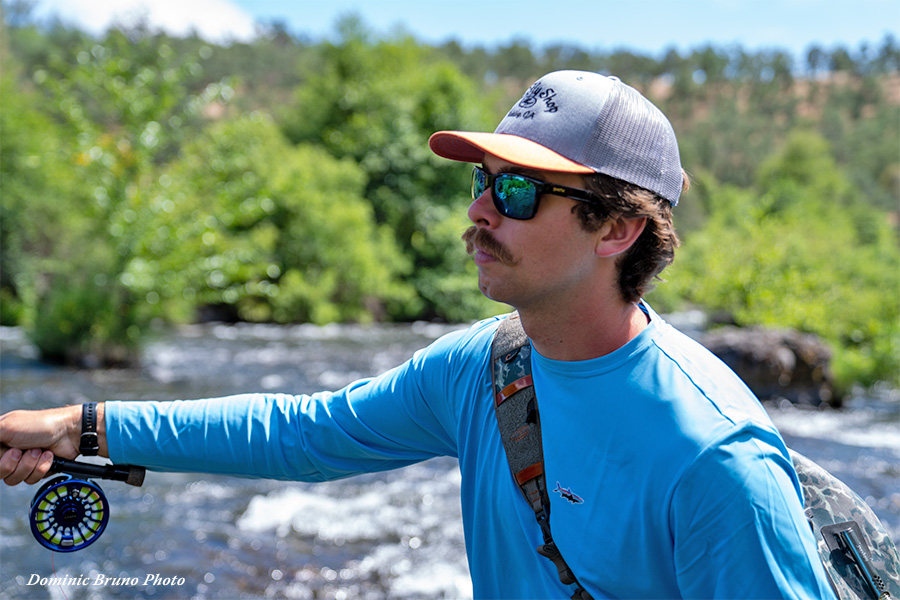
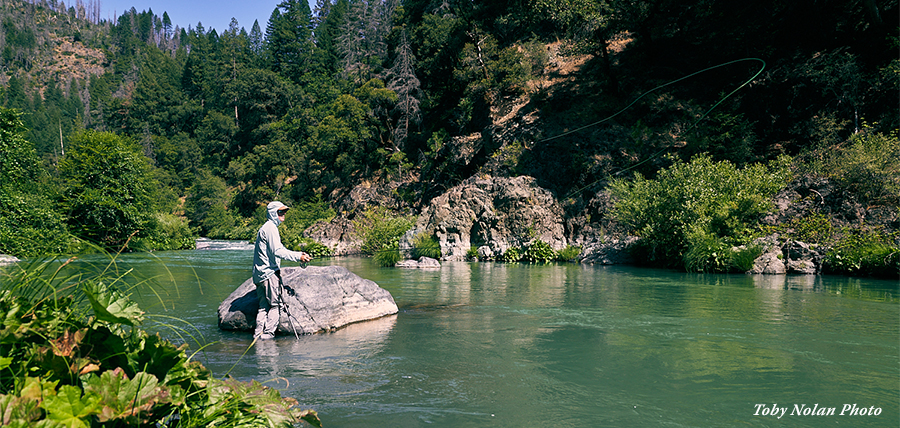
Jordan Taylor (JT) wearing sunglasses while fly fishing

Blue and green mirrored lenses will block the most light with only 10% light transmission making them great for full sun days. Blue mirrors are best used for bright days on open water where the green mirrors are better utilized for sight fishing in the flats, rivers/streams, and shallow lakes.

  • Copper Green
    • Copper Tint
    • 10% Light Transmission
    • 100% Polarized
    • Bright sight fishing for full sun
  • Blue
    • Grey Tint
    • 10% Light Transmission
    • 100% Polarized
    • Open water non sight fishing

The Sunrise Silver (yellow) lens compliments either of those lenses with 27% light transmission. Living in Northern California we are no stranger to the sun which makes you think this lens isn’t necessary, but I have been pleasantly surprised with how much I use them. They have been an easy option on overcast days, and perfect for any morning/evening even on the sunniest summer days.

  • Sunrise Silver
    • Yellow Tint
    • 27% Light Transmission
    • 80% Polarized
    • Low light conditions
    • Specialty lens

Costa’s new Rose Gold lens offers the most versatility with a light transmission of 14% to bridge the gap between the darker mirrored lenses, and lighter yellow lens options. Our local guides helped develop the brightness of them to find the best balance of shading from our bright summer sun, without having to take them off and fish unprotected for the first and last hour of light.

  • Gold/Rose
    • 14% Light Transmission
    • 100% Polarized
    • Most versatile lens available
    • Going to be the best Trout lens EVER!

Copper Silver has always been a staple for versatility with 12% light transmission to cut the glare on sunny days, while giving you a warm viewing experience on cloudy days. My coworker Shannon has Type 1 diabetes which has caused him to be very sensitive to light, and he’s been wearing this color for years. I’ve never seen him outside any time the sun is around without them on. They allow him to see clearly when driving to his favorite spots, and most importantly giving him the edge to spot fish trying to disguise themselves from us under water.

  • Copper Silver
    • Copper Tint
    • 12% Light Transmission
    • 100% Polarized
    • All around sight fishing
    • Most versatile sight fishing lens

The Grey Silver mirrored glasses are a great option for any of your non fishing activities. They offer a cool viewing experience with minimal color distortion. When driving in high sun situations the Grey Silver mirror will reduce glare from your hood or other vehicles to minimize eye strain and get you to your destination safely.

  • Grey Silver
    • 12% Light Transmission
    • 100% Polarized
    • Driving/Lifestyle/Non Fishing

Lens Material:
There are basically two options, glass or polycarbonate (plastic). Some people prefer the lightness in weight they get from polycarbonate lenses, but you have to be extremely careful not to scratch them. One grain of sand or debris and using your shirt or lens cloth to clean them, and they are ruined, permanently. Many of us here, even though they are a bit heavier, prefer the glass option for our lenses. Glass is more durable in the long run and you won’t have to be as concerned about scratches on your lenses – longer lifespan.

Mirroring is also a great feature on sunglasses that you are going to use stalking tailer’s. Mirrored lenses cut down extreme glare common on the flats. While not as important for many freshwater applications, you will appreciate mirrored lenses on a bright sunny day in the Caribbean.
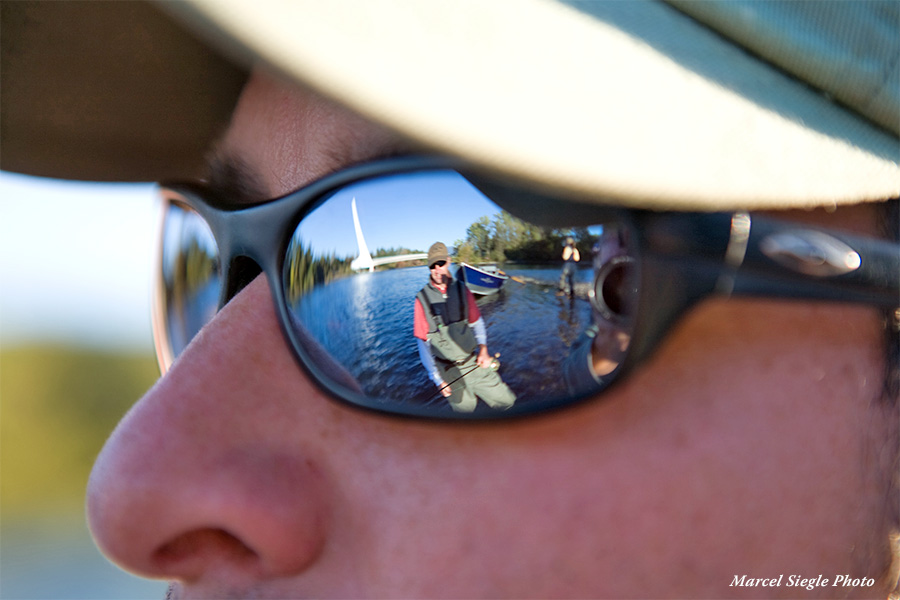
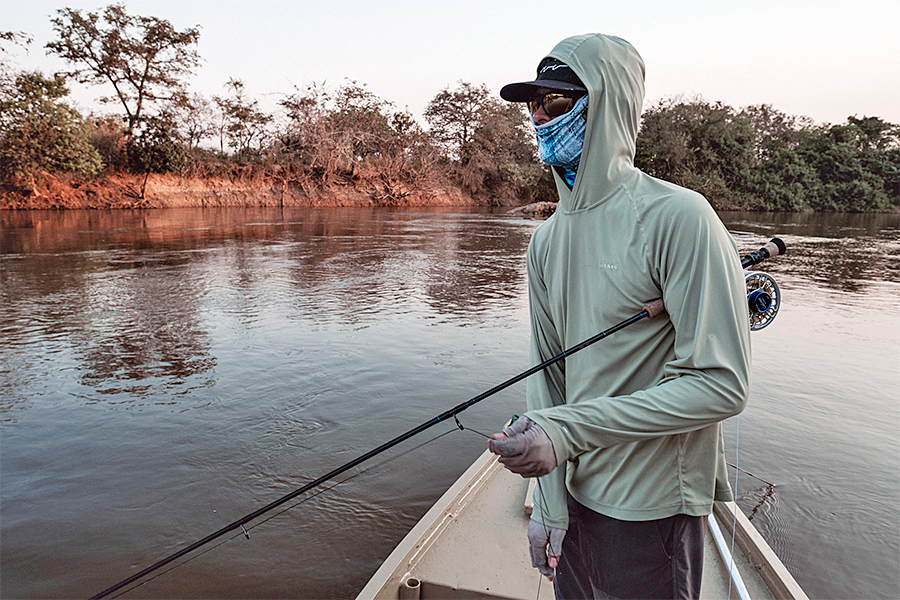
Angler wearing mirrored sunglasses

Frame Choice & Fit:
“Frame choice is a very personal decision. Everyone’s face is shaped differently. Frames that I love might slip right off of your face, and frames that you love might put huge pressure behind my ears! You want to get a frame that fits YOU perfectly, something that fits snuggly and is stable on your face, but doesn’t pinch the bridge of your nose, or put pressure behind or over the ears. You also want to make sure you are not getting a lot of direct light coming around the frame into your eyes – called “light leakage”. Get a pair that wraps a little better and keeps out stray light. You definitely need some air flow, though, so they are not constantly steaming up. You also do not want to have a bunch of the frame visible to your own eyes when wearing them. This is very distracting, and restricts your view. Try on a bunch of different frames until you find the right one for you.”

“The options are endless and finding the perfect pair is a lifelong hunt, just like flats fishing itself… Costa Del Mar, Smith, Bajio, Oakley, Maui Jim, and Breakline, among others, all make fantastic high-end sunglasses for angling. I have fished with most of them and, at the moment, my favorites are Costa Del Mar 580g Green Mirror lenses on Reefton frames. Comfortable, durable and I can tell what color a permit’s eyes are at 100 yards. Give us a shout and let us help find the perfect pair of x-ray goggles for you, too!”   – Justin Miller
https://catalog.theflyshop.com/sunglasses/

(800) 669-3474 | (530) 222-3555 | info@theflyshop.com

Gear Review: Patagonia Travel Luggage

800 • 669 • 3474

Patagonia Luggage Gear Review 
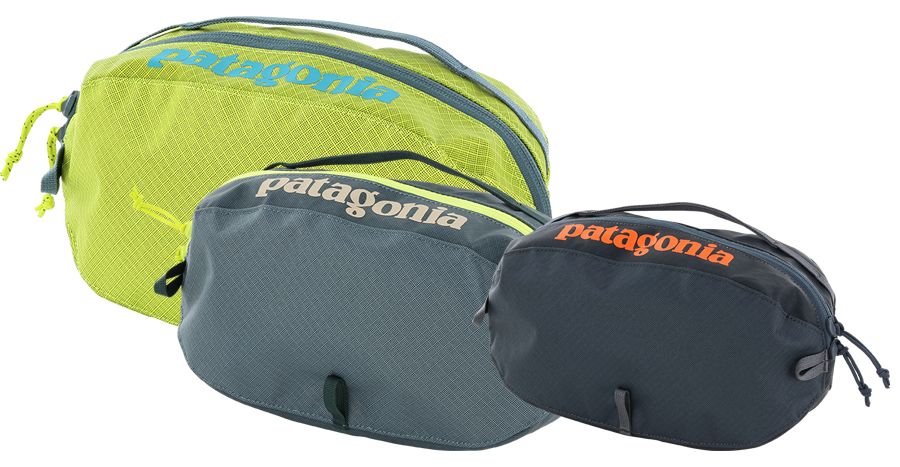
Black Hole® Cubes (3L, 6L, & 14L)
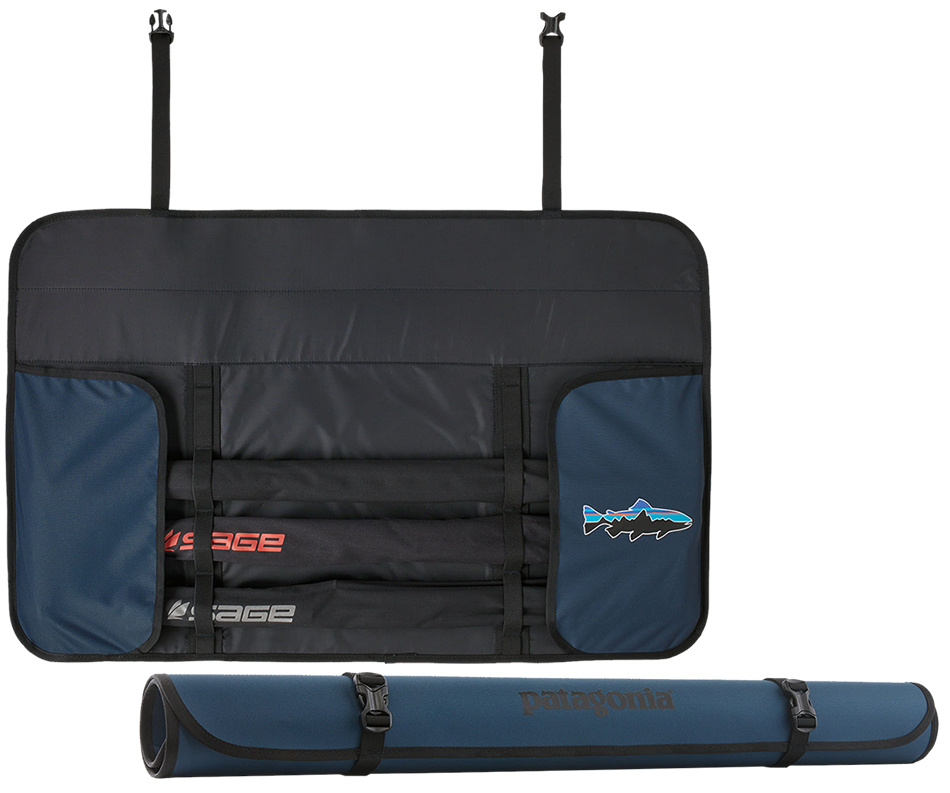
Patagonia Travel Rod Roll
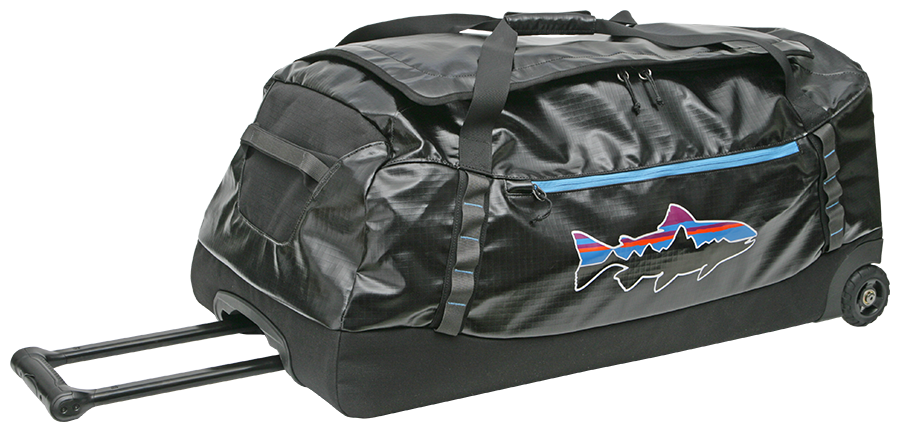
Black Hole® Wheeled Duffel

On my most recent trip to the Colombian jungle in search of peacock bass, I had a chance to try out the new Black Hole® Cubes in conjunction with my usual travel set up of the Black Hole® Wheeled 100L Duffel and Patagonia Travel Rod Roll.

This is a gear review as well as my thoughts on the best way to get your rods, reels, clothing and gear to the majority of our remote angling destinations that we represent all over the world.

I have done quite a bit of traveling over the years and there is no one perfect way to pack and travel for a big trip. Each location is a little different and even for me it has changed over the years depending on where I am going and lately on airport security policies. One of the major decisions in the past was either carrying on or checking my rods, reels and lines. The idea being if you carry these items on and for some reason your checked bag was lost, you could still fish until your bag showed up and the trip wasn’t lost.

On this particular trip we were pretty restricted on weight (33lb for checked bags and 11 pounds for carry-on). Typically this would be easy for me, but since I was the host I was bringing some extra stuff, just in case, so I was trying to keep everything pretty lightweight to allow for extras. The Cubes are super lightweight, but also plenty durable, 300-denier 100% post consumer recycled polyester ripstop. All three weighed in at a little over a pound, empty (20.8 oz).  I really wasn’t adding any weight, just a way to keep all my things separate in the big open space of the duffel.

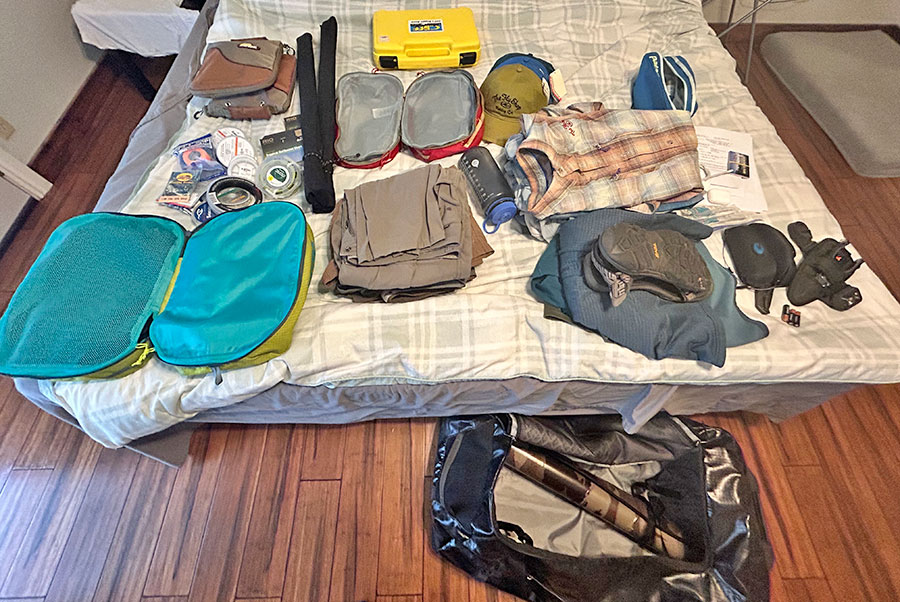
Packing for a fly fishing trip

I have used zip locks before to separate my things, and it works, but the Cubes made it a little classier, more functional and definitely more durable. I used the 3L Cube for my toiletries. I have a toiletry bag at home but it is pretty clunky and with a hard bottom, it is relatively heavy for what it is. Switching over to the cube was nice. I put all my shower/bathroom things I needed in there and it was all together in one place, in my duffel, easy to find. For the 6L cube, I put my fishing terminal tackle/gear in that one. All of my tippet, leaders, extra lines, pliers, wire bite, nippers, tape, leatherman, etc. Same thing, it was all together, so once we got to the river, I could just pull it out, carry it to a table and I was ready to rig up my rods. For the last 14L cube, I put all my socks, underwear, buffs, etc in that one. For the most part I usually just throw these things in my bag, so I realized on this trip, it was nice separating them, so I could find them easily and they weren’t all spread out on the bottom of the duffel bag. These Cubes were a great way to keep my bags light while making it easy to separate my gear into more manageable units. Many duffel bags have pockets and dividers, but the Cubes allowed me to pull out this stuff and move it or take it with me. Depending on what you use them for, they could be taken with you on the river/lake/water.

Patagonia Travel Rod Roll

Also as I mentioned above, the Black Hole® Wheeled Duffel along with the Patagonia Travel Rod Roll are my go-to ways to travel these days. With these I will carry-on the plane a waterproof backpack with all my necessities for travel that doubles as a boat bag/fishing pack once at my destination. The Black Hole® Duffel allows me to get around the airport pretty easily with the wheels and the telescoping handle. It is pretty water resistant and durable, so besides float trips, it can handle boat rides getting sprayed or being out in the rain/weather and is tough enough to handle the beating on the conveyor belt and the airport guys tossing it around. I can fill it up and it is never over 50 pounds (typical airline limit) plus the Rod Roll fits perfectly in there keeping them protected at the bottom of the bag.

Patagonia Black Hole® Cubes (3L, 6L, & 14L)

Lately, many international airports are starting to get a little more strict on carrying on rods, reels, and lines. You can typically get through security in the States and get to your destination, but coming back, they are making you check them. So, nowadays you have to be ready for this. Of course you can simply put your aluminum tubes, or a rod-filled custom made PVC tube in your checked bag. However, the Rod Roll/Black Hole® Duffel, in my opinion, is the best way to do this. The Travel Rod Roll is lightweight (about the same as all 3 Cubes), I can get 5 rods (it is only supposed to hold 4) in there, and put it at the bottom of the Black Hole® Duffel, throw my clothes, reels, plus Cubes on top and my rods are secure and protected. No problems to this day. My last two trips, I had to check my fly rods/reels in both Colombia and through Istanbul getting to Tanzania. Argentina has had this policy in place for a while now and Mexico is following along. I’m not sure what is so dangerous about a fly rod, reel or line, but it is pretty hard to explain common sense in an airport security line, to a guy that knows nothing about fishing, when they have your carry-on apart and rods all over the place. And it isn’t fun having to go back through check-in and security especially when you have long lines. As stressful as it is to worry about your luggage getting lost and you showing up at your destination with no rods, reels and the ability to fish, it seems to be the way most airport security is going. Even if you can carry the Rod Roll on the plane going to your destination and check it on the way home. You want to be set up and ready for this option.

Patagonia Black Hole® Wheeled Duffel Bag

I love the carry-on rod cases (Orvis and Fishpond) for taking rods/reels on the plane and the sense of security knowing that my necessary gear will be there when I get to the lodge. And at certain destinations (Alaska, Bahamas), this is the way I travel, but with changing airline security at different airports around the world, the Patagonia set up is the way to go for the majority of International destinations. It is best to book flights with the least amount of connections, check your Black Hole® Duffel, put an Air tag in there (if you have one) and hope that everyone does their job getting your bag to where it needs to be. Unless I am floating, I will be using the Black Hole® Duffel, Travel Rod Roll and Black Hole® Cubes as my go-to set up.

In Colombia, a travel buddy was lugging around his heavy waterproof duffel (no wheels) with his rods in aluminum tubes in the bottom of his bag wearing out his shoulders. When he got home, he got on our website and updated his travel gear. Give it a try, I think you will like it.

If you would like to hear more about any of these products or my hosted trip to Colombia please don’t hesitate to contact me at 800-669-3474 or via email at argotti@theflyshop.com

Erik Argotti
Destination Specialist
The Fly Shop, Inc.
4140 Churn Creek Road
Redding, CA 96002

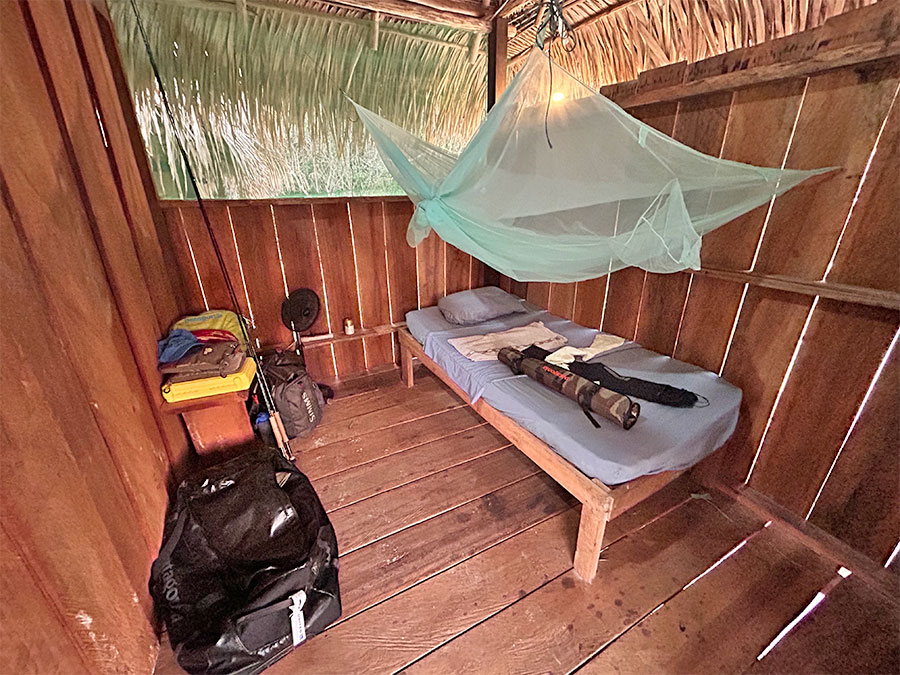
Patagonia travel luggage in the room in Colombia

Gear Review: Skwala Sol Wading Pant

800 • 669 • 3474

What I’ve found after 30+ years working in fly fishing is that everyone says they have the most comfortable everything. “Our wading pants and tech sun shirts are the very best and you’ll want to wear them all the time.” I’ve heard that so many times I’m pretty numb to these exaggerations.

I’ve worn so many “fishing” pants either for fishing or for everyday wear hoping that I had finally found something that truly makes me “want to wear them all the time.”  Well, good news!  I have found a pair of fishing pants that are amazing for ALL aspects of life, except a formal dinner.

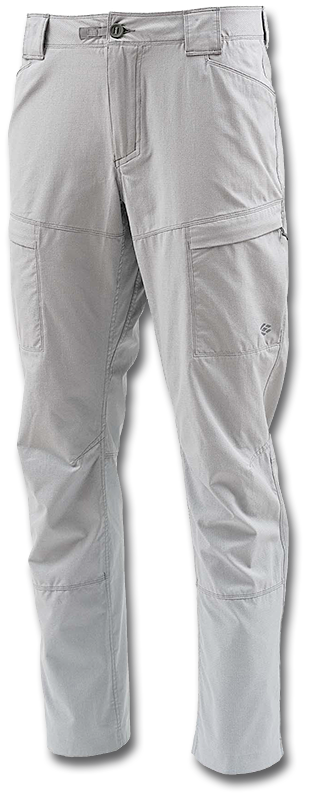
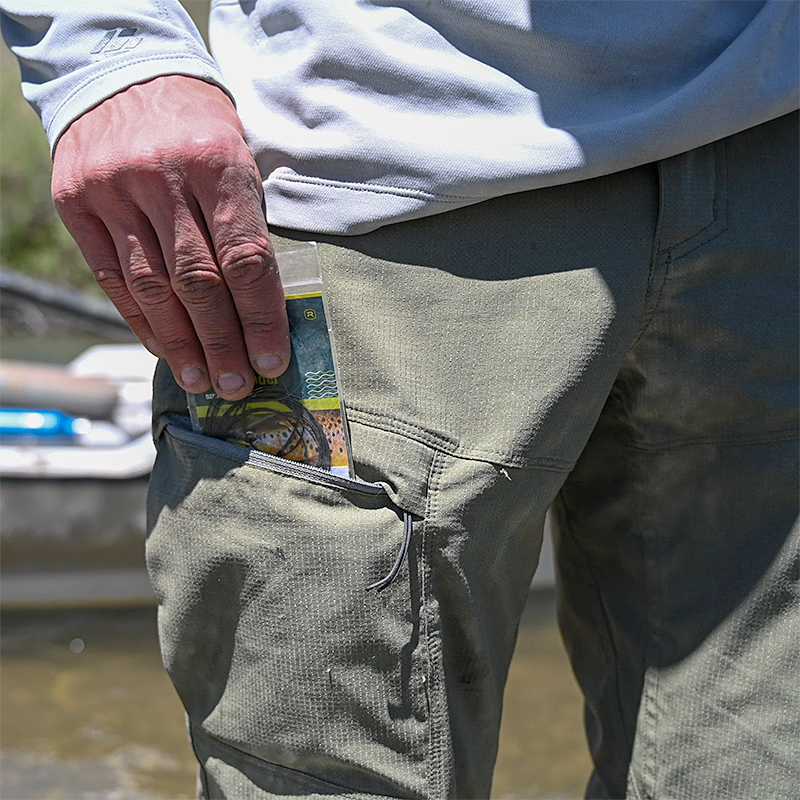
Skwala SOL Wading Pant in ShadowA little more than a year ago I ordered a pair of Skwala’s Sol Wading Pants, not free from the manufacturer, at a pro price. I thought I would give them a try after seeing the sample and feeling the material. They had all of the features that I’m drawn to and I needed some new pants anyways. When I saw them in person, from the samples they sent us, I thought they checked all of the boxes. The articulated legs and microporous fiber used seemed to be ideal in Redding for wet wading our local rivers and streams as well as wearing for everyday use. I wasn’t sure that they would be the answer to anything but thought in the worst case scenario they would be great for kicking around on the weekends or wearing to work. They have plenty of pockets for daily use and the side and back pockets have zippers rather than velcro, which I always prefer.

Skwala Fishing’s CEO, Kevin Sloan, had told me that these were the “best” and I was thinking, “sure they are, just like all of the others.” I’ll be the first to admit when I’m wrong and give credit to the person that proved me wrong. The first time I wore them was a visit to the coast to see my daughter and do some camping. No, not a fishing excursion just yet. They were extremely comfortable for the drive over, which isn’t a surprise as they feel like your favorite pajama bottoms. The true test on this initial trip was going to be when I stopped at the ocean and let my dogs run on the beach and swim. We hit the coast after the long drive and I let the boys out to run and play a bit. Not sure if anyone else has Labradors, but if you do, you know they love the water, so they were in the Pacific Ocean in no time. Again, not your normal fishing test yet, but a test on how quickly these things would dry. I was thinking to myself, “great, now I’m going to have to change when we get back to the truck.” We played in the water, ran on the sand and enjoyed the wonderful smell that you only get from the ocean. After an hour or so we returned to the truck and to my surprise, by the time we reached it my pants were dry. Yes, they were a bit sandy, but that just brushed off and we were back in the truck and headed to the campsite.

Since that first trip I’ve worn them to do just about everything, from golf to travel. I finally was able to put them to the fishing test a couple of months later on the Upper Sacramento River. Since it’s still hot here in Redding, this was in September, I was able to wet wade. I was a bit concerned about wear and tear with the weeds getting spiky and much of the brush being dry from the hot summer. But, there’s no better way to test this stuff than to take it out and see what happens. Again, with dogs in tow, we pulled off at the Delta exit and geared up for a light day of fishing and some dog swimming. I picked Delta as I know a few holes that the dogs can enjoy between fishing runs.

Side pocket on the Skwala Sol Wading PantAgain, these pants checked all of the boxes. With all of the pockets I was able to carry all of my fishing gear for the day without needing a pack. I of course did have a waterproof backpack, the Patagonia Guidewater Backpack, with me though as I brought lunch and some supplies for my dogs.  This isn’t the case for everyone I know, but I’m a minimalist when it comes to my fishing gear. We trudged through the brush when needed and also waded through the river at other times. Just as Skwala says about their pants, “Slogging through current while picking apart boulder pockets.”, they worked great for this exact scenario. At no time during the day did I feel that my pants were slowing me down or dragging in the water. The tapered, articulated cut on the legs makes for a very comfortable day in the water.

We returned to the truck a few hours later with happy dogs and a few trout to hand. The goal of the day wasn’t so much to catch a ton of fish as it was to have a great time and test out these pants. For me, they passed every test I threw at them. By the time we got back to the vehicle and put everything away, which wasn’t much, my Skwala Sol Wading Pants had completely dried and I only needed to pick a few foxtails and stickers out of the legs. There were no tears or rips from the brush and they looked as though I just took them off the clothesline.

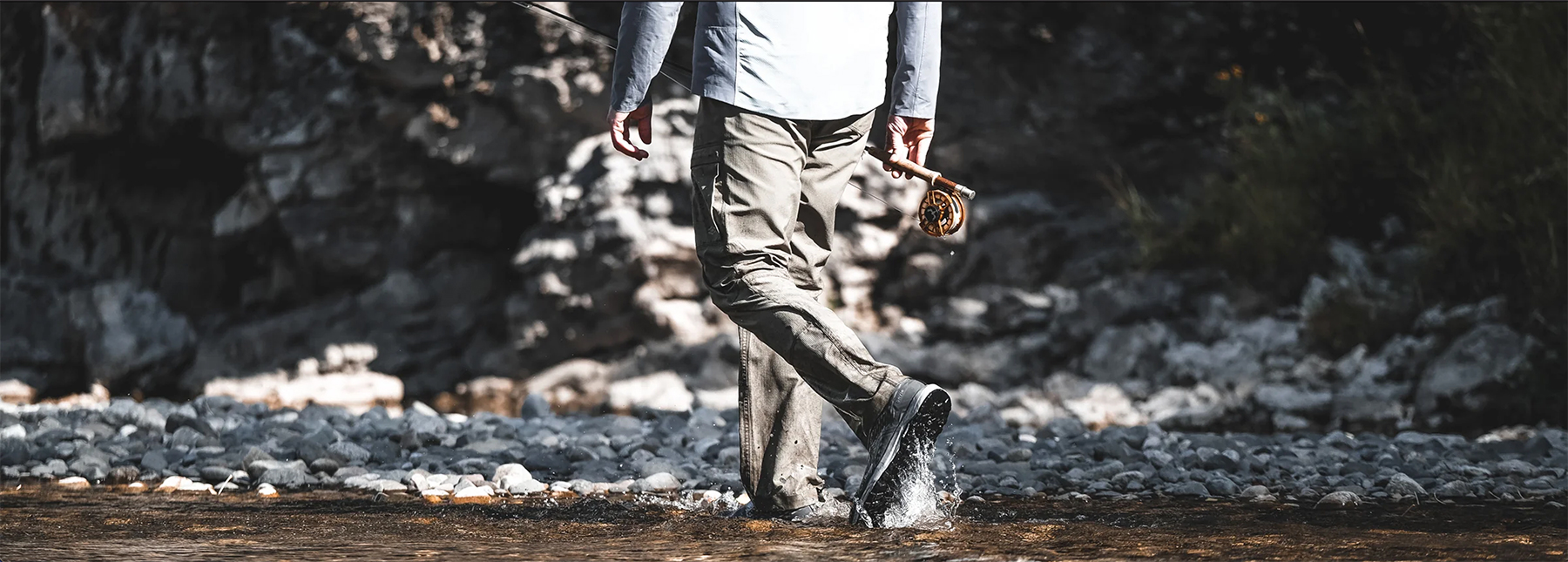
Bryan Quick wet wading the McCloud River in his Skwala Sol Wading Pants

Conclusion:
I’ve worn lots of “wet wading pants” in my time and in my opinion these are the best I’ve ever put on and used. A bit on the shorter side (32” inseam), but that works great for wet wading. I think Skwala hit a homerun with these pants and I would strongly recommend that you give them a try for yourself whether it be in the salt or on your local river. As Pat Pendergast stated in his “Gear Review:  Skwala RS Jacket & Waders,” well done Skwala Team!

I would also recommend that you read Justin Miller’s gear review that he wrote in December of 2022 on these same pants and the Skwala Sol Tactical Hoody – https://www.theflyshop.com/gear-review-skwala-sol

Gear Review: Simms G4 Series

800 • 669 • 3474

The Simms G4 lineup was made for those days when Mother Nature throws everything at you.  Whether it is freezing cold conditions, a pouring monsoon, and even in a blizzard snow storm, you’ll be comfortable and protected from the elements in this set up. The G4 lineup has you covered – it’s the best of the best!

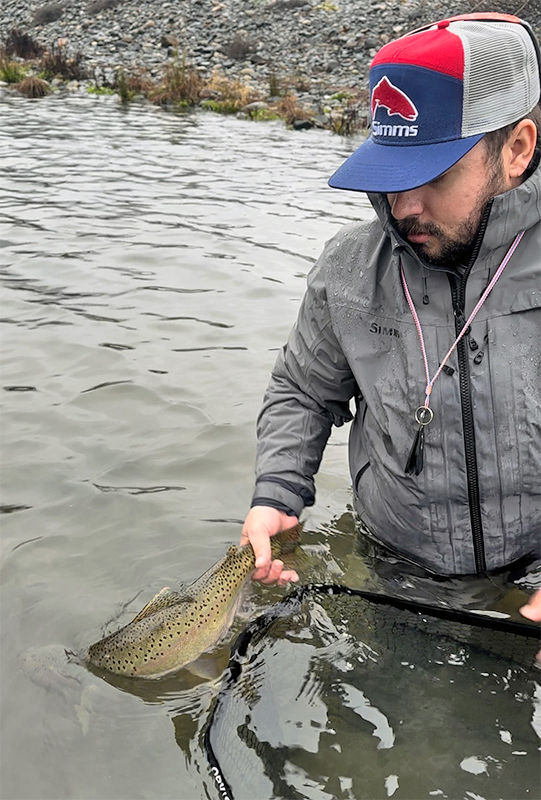
Cody Hunt releasing a fish while wearing the new Simms G4 Pro JacketMen’s G4 Pro Wading Jacket:
Simms’ newly redesigned line is a big improvement over the previous G4 series. I’ve had the opportunity to fish in this new jacket for a little while now and have been very impressed. The G4 jacket is cleaner, has a more sleek design, from wearing it on the water, going for a hike, or taking it out on the town with your buddies. It can do it all. The pockets are much deeper to hold bigger fly boxes, tippet, and any other accessories you want to bring with you. There is even a little bungy on the inside with a microfiber cloth to wipe off your sunglasses. The pocket zippers are hidden with a storm flap to keep water from getting inside, unlike other traditional wading jackets. In the pockets themselves is another zipper you can access from inside the jacket. Once you unzip it, you can put your hands through the jacket itself, allowing you to put your hands into your wader pockets to warm them up on those frigid days when your hands feel like they are about to freeze and fall off. The 3-point adjustable hood tightens up nicely around your hat to keep water from getting in the jacket and creeping down your neck from all angles.

Quick Features:

    • 3-point adjustable storm hood with a high-visibility center panel
    • Unique storage array includes dual zippered chest storage pockets with interior stretch mesh dividers.
    • Zippered side-entry hand warmer pockets have integrated pass-through zipper for wader access without removing your jacket.

Cody Hunt wearing the new Simms G4 Pro WadersMen’s G4 Pro Zippered Waders:
Simms’ waders have many new features to them as well. The gravel guards are redesigned with a slimmer, snug fit to keep rocks and grit from getting into your boots and they took away the little hook for your laces to keep line from  getting stuck on them. Previous models had a bulky strap with heavy duty buckles. These are now much more slim-line and much more comfortable on the shoulders, reducing fatigue. Buckles are no longer a part of these as well, it’s all an elastic pull tab adjustment. You can change it all on the fly from a quick pinch onto the locking device, then  reaching into the waders to pull the tag ends tighter or looser. The 4-layer GORE-TEX® material comes up a little bit higher on the legs for a more rugged wader. Zippered pockets on the sides are much deeper, as well as having a very warm fleece lining on the inside to give you the feel of having a warm baby seal in there to hold onto. These pockets are now 100% waterproof also, so if you take a swim your keys, wallet, phone or anything else will be bone dry. Overall these are the best fit and most comfortable waders out of all previous G4 models. From the suspender system, the deeper pockets, the belt, it all adds up when you’re on the water to have a wader that is comfortable and can do it all for you. I am truly impressed with this whole lineup.

Quick Features:

    • Dual zippered stretch woven chest pockets for quick access to fishing necessities.
    • Zippered, high-pile fleece lined hand warmer pockets for storage and warmth.
    • Dual interior waterproof zippered pockets for totally submersible protection.
    • Low profile, adjustable spacer mesh suspender package.
    • Front belt loops allow you to unbuckle, have the belt stay in place and will not drop down behind you.

If you’d like to find more information on either of these products you can click on the product name above and it will take you to our online catalog which has more information on the products as well as full sizing charts for both.

In conclusion, I would say that this new and improved version of both the G4 Pro wader and jacket are worth the money. I’ve used several iterations of the G4 Series and this one is by far the best that I’ve worn. I’d highly recommend either or both of these items if you are looking for the best out there. If you have any questions on these G4 Pro products don’t hesitate to give me a call.

Cody Hunt
(800) 669-3474
cody@theflyshop.com

Staff Bio – Cody Hunt

800 • 669 • 3474

I was born in the bay area outside of Redwood City, then my parents made the move up to Northern California when I was still very young. My dad would take us up to the eastern sierras every year for the trout opener while we still lived in the bay for years before I could even walk. He spent his whole life fly fishing and spin fishing out there and knows it all like the back of his hand. He first put a fly rod in my hand when I was 5 years old, teaching me how to cast on our lawn or at least attempting to cast anyways. I really got a grasp on fly fishing when I was about 12, after spin fishing for years. After the move up north, I began exploring all of our creeks, lakes, rivers and every other piece of water I could find. When I turned 18 I started guiding locally as well as spending a few seasons in Alaska on the Upper Nushagak, at Outpost on The Nush.

Q&A with Cody Hunt:

Cody with his Dad as an infantHow did you get started in fly fishing?
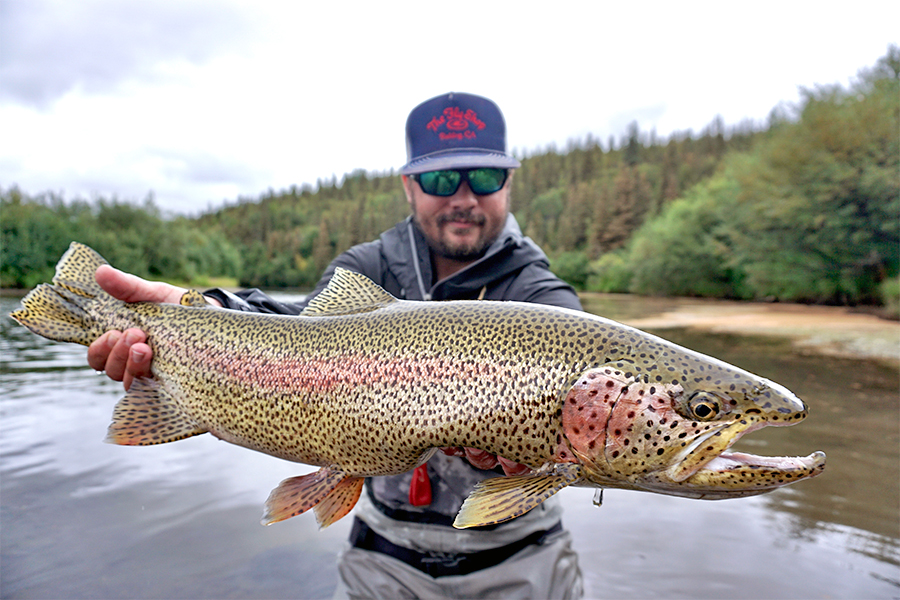
My dad got me into fly fishing at an early age, but I fell out of it quickly and went back to spin fishing. When I was 12 I really started to get into it and realized how fun and much more exciting it is. My dad has always pushed me to get outside and fish as much as I can so that’s all I did growing up. He was definitely the biggest influence on my fishing background.

What does fly fishing do for you that keeps you coming back for more?
The chase and pursuit of fish just trying to trick them into getting a mouthful of feathers an thread. From making an accurate cast and a perfect dead drift to fool the fish into eating and just being outside. Not to mention the overall fight, that’s the best feeling around I don’t care who you are.

Favorite fish to pursue?
Easy answer, Steelhead!

Cody Hunt holding a steelhead

What fly fishing destination is on your bucket list?
That’s a hard one I’d have to say GT’s in the Seychelles or golden dorado in the Bolivian jungle.

Favorite fly rod and why?
It would be my Sage DS2 6wt that my dad gave to me when I first started fly fishing. I’ve taken it from the Lower Sacramento to Alaska and caught my two biggest rainbows both here and up north on it.

Favorite reel and why?
The Galvan Torque. It’s smooth, has a good drag and it’s a family owned company based out of Sonora, CA.

Favorite fly and why?
A straight up pheasant tail. It works on every piece of water that has fish in it. No Question.

What is your greatest fly fishing extravagance?
Guiding and fishing in Alaska.

Which living or non-living fly fisher would you want to spend a day fly fishing with?
Bill Schaadt, fishing the lost coast during the 50’s must have been unreal.

Who is your favorite writer?
Theodore Roosevelt and John Gierach

What single issue in fly fishing do you feel has the greatest adverse potential?
Social media causing over-fishing and overpopulation of anglers to fragile watersheds. From mishandling fish to environmental harm.

Cody Hunt holding a rainbow trout

What is  the most memorable fly fishing trip you’ve taken?
My last trip to the eastern sierras with my dad after us not fishing there for over 15 years. It was a very special trip full of big fish.

Which talent or natural gift would you most like to have?
To teleport – then I can fish wherever I want with a snap of my fingers.

Who are your heroes in real life?
My parents encouraging me and helping me follow my dreams on what i want to do.

What is your fly fishing pet peeve?
Elitism. Everybody has their own way of doing things and it doesn’t make one better than the other as long as you’re happy doing it. Also grabbing fly line with your teeth, like why.

What do you most value in your friends?
Humor, encouragement and loyalty.

If you were to die and come back as a person or a thing, what would it be?
Bald eagle

2023 Holiday Gift Guide

800 • 669 • 3474

Christmas is quickly approaching and we have assembled a terrific list of some of our personal favorite gift ideas for the fly fisher in your life. From stocking stuffers to travel getaways, or the always popular and versatile gift card, there is something for everyone.

Not seeing exactly what you want, give our expert angler staff a call (800) 669-3474 | (530) 222-3555 and we are happy to point you in the right direction.

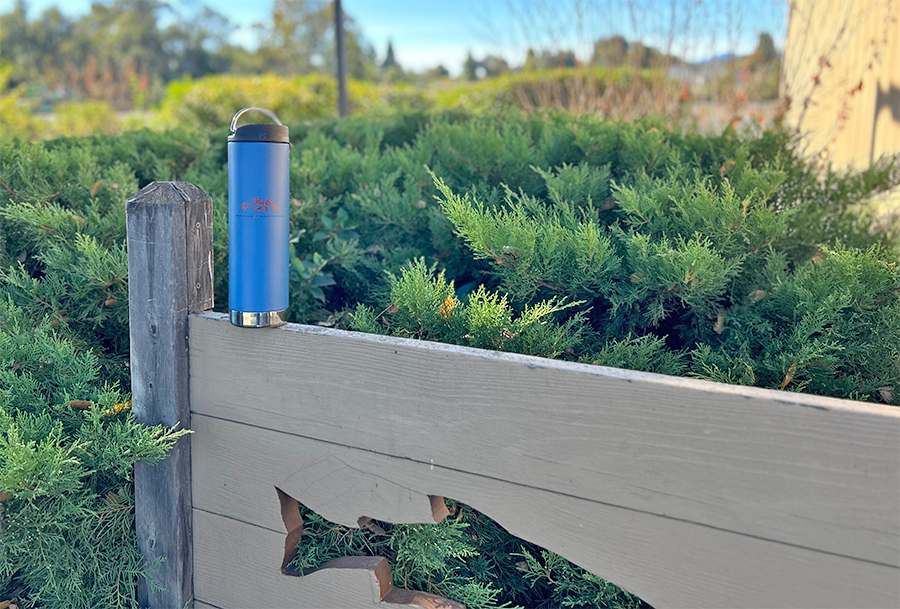
Klean Kanteen 20 Ounce TKWide Insulated Water Bottle w/ Café Cap

Klean Kanteen 20 Ounce Insulated Water Bottle – $34.95
The “Kick Plastic” push is real and important.  Every angler, every one, should have a reusable water bottle for fishing or a trip to the hardware store on the weekend. This bottle is the perfect size and it fits most, if not all, cup holders and keeps things warm or cold for hours.

  • Made from certified 90% post-consumer recycled 18/8 stainless steel
  • Climate Lock™ keeps contents iced up to 59 hours
  • Chip-resistant Klean Coat™ powder coat finish
  • BPA Free
  • Won’t retain or impart flavors

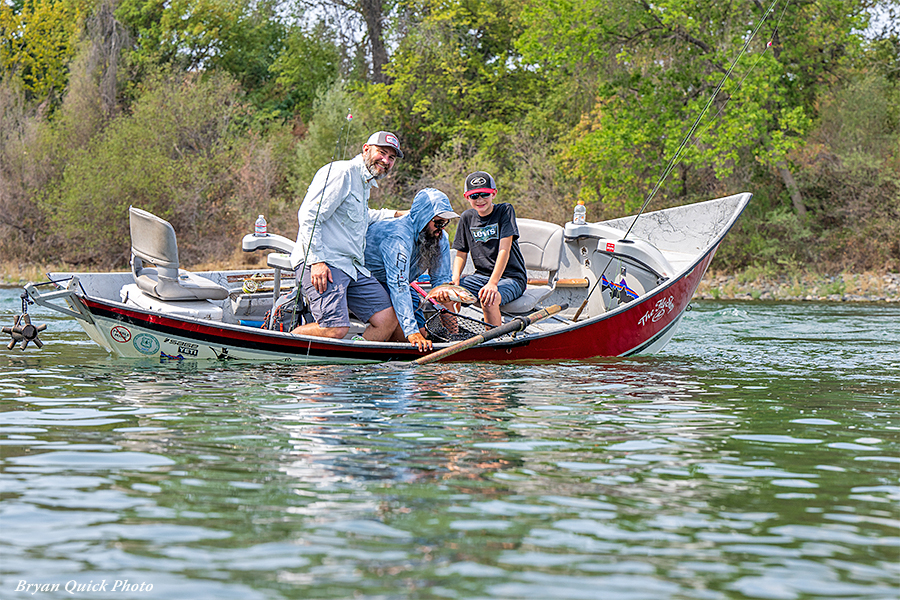
Father and son fishing with a TFS guide on the Lower Sacramento River

Guided Fly Fishing Trip in Northern California – $625 for 1 to 2 anglers
There is no greater gift than the gift of time together.  Spending a day on the water with one of our excellent guides allows you to spend quality time without any burdens of rowing, finding your fishing spot, etc… Our guides provide all of the terminal tackle including lunch, so all you have to do is show up with a fishing license and have a great day of fly fishing.

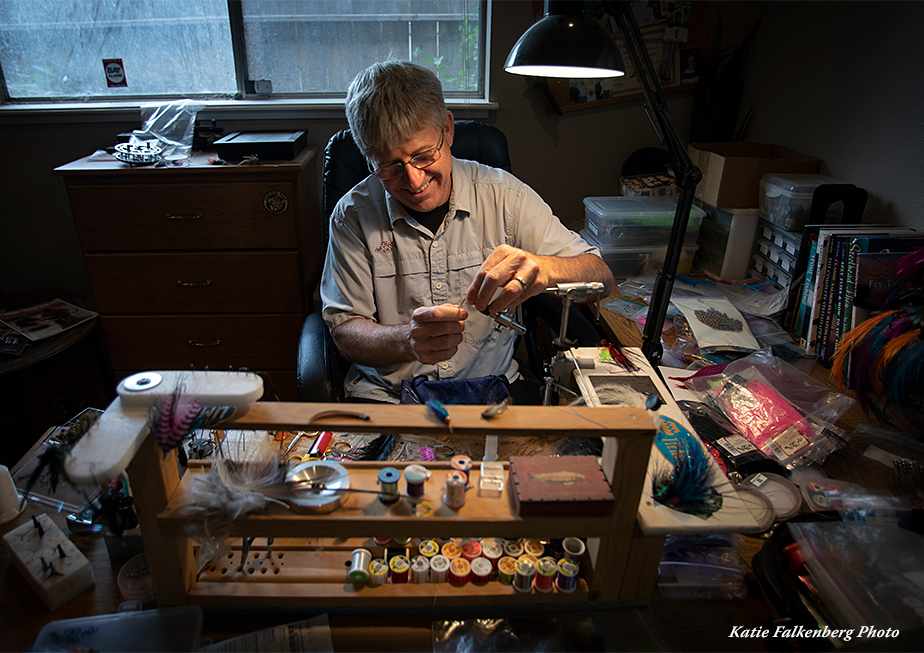
Mike Mercer at the fly tying vise

Wapsi Deluxe Fly-Tying Kit – $109.95
If you are intrigued or interested in getting into fly tying, there isn’t a better kit out there to get started.  This deluxe kit comes with everything you would need to tie your own flies. It includes all the tools and materials needed to tie 17 different fly patterns and comes with the popular Wapsi® fly-tying handbook, which offers excellent beginner instruction and good color photos for each tying step. A great gift for a young fly fisher!

The Fly Shop's Fresh H2O Outfit

The Fly Shop’s H2O Rod/Reel/Line Outfits – $295.00 – $445.00
There is simply no better set up to get started in fly fishing than The Fly Shop’s signature lineup of fly rods and reels.  Each rod features forgiving actions combined with responsive high modulus graphite. It’s a marriage of design and materials that compensates for errors and a less than expert casting stroke.  Choose your reel from our M2A or L2A, depending on your price comfort, and we throw in the quality Scientific Anglers fly line to make it complete.  An extra bonus is that every TFS fly rod comes with an extra tip to keep you fishing even in the event of breakage.

  • In September we added 2 models to our Indicator rod series and they have been a hit!

Christina Fasiano holding a fish at Rock Creek Lake

Gear For The Woman Angler
We stock a ton of fly fishing items specifically designed for women. Everything from wading belts to waders, sun protective shirts, puff jackets, raingear, wading boots, shorts, pants, skorts, we got ‘em and more coming in 2024. Give Christina a call (800) 669-3474 or shoot her an email and she’ll help you pick the perfect gift.

20/20 Magnetic Tippet Threader

20/20 Magnetic Tippet Threader – $14.00
This little gem is a gift of love, believe us!  There is nothing more frustrating than not being able to tie on a fly under low light conditions with fine tippet, especially when a hatch is on. This little gadget, at under $15, is a lifesaver for those of us that need readers. Spare your flyfisher the agony and hook him up with this easy to use magnetic threader – it’s a game changer…

Angler wearing a Buff while fishing

Buff® – $21.60 – $24.00
This is a terrific gift for anyone on your list who plays or works outdoors. It may just save their lives. With 50+ UV protection, 4-way stretch material, seamless construction, built-in bug deterrent, a variety of stylish colors & patterns, and now odor control, it is easy to see why no one has been able to match this product for comfort and sun protection. You can never have enough of them around.

The Darwin Ranch  – Call to get further details and package prices
This Darwin is a historic 100+ year old working ranch, outside of Jackson, Wyoming offering private fishing on the trout-filled Gros Ventre River along with family-fun activities like horseback riding and packing, hiking, float trips, and wilderness camping. This is the ultimate family or couple getaway where multiple interests will keep everyone happy. Make them smile this Christmas, with a lifetime of memories.

Assorted fly boxes

Fly Boxes$3.95 – $59.95
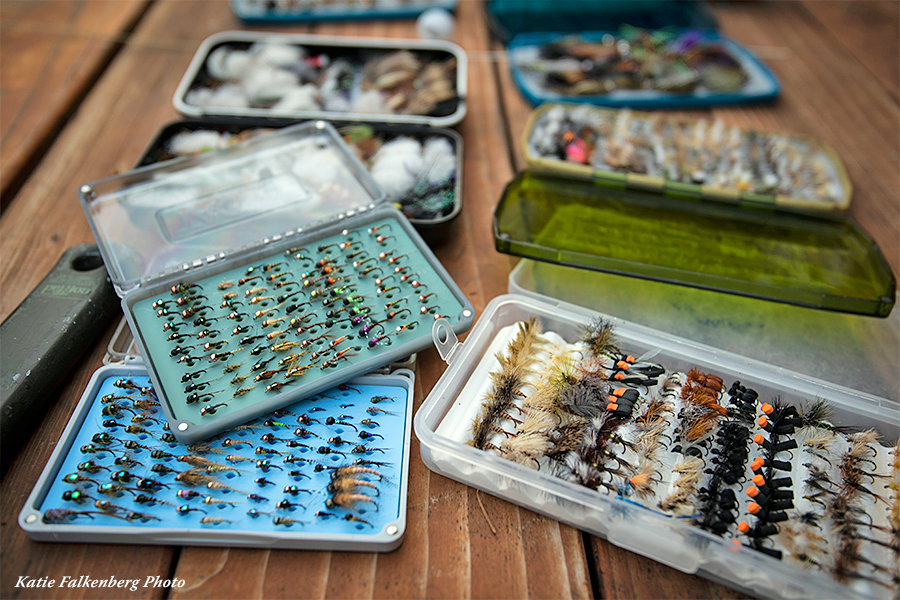
Just like flies, you can never have enough fly boxes. They are an inexpensive accessory, but vital to every fly fisher. The fly box is a simple way to organize, safeguard and store your flies as well as have them ready to go when on the water. From fancy to simple we have them all and for any application, dries, nymphs, streamers, Spey, saltwater, you name it.

The Fly Shop's Gift Card

TFS Gift Card – You choose the value
Sometimes gift cards get a bad rap, but nothing could be further from the truth, especially when trying to find that perfect gift for the fly fisher in your life that you “think” has everything – they never do… We guarantee there is something they have their eye on and a gift card is the perfect solution.

Gearing Up for Fall Fly Fishing

800 • 669 • 3474

In our last post we covered the “Clothing for Fall Fly Fishing”.  As we said we would, here is the follow-up to that article with the gear needed to switch seasons.

As summer gives way to autumn, some, not all, anglers look to put away our 8’ 4-weights and size 18 PMD’s and break out the big sticks. We dust off our puffy jackets and pull out the fly boxes that don’t require reading glasses to tie on the offerings inside.

The question for this article is, where should we start?  A lot goes into selecting the right gear for steelhead, aka chromers. Let’s start with rods. Then we will take a look at reels, lines and flies as well.

Zach Miller casting the new Scott Swing on the Trinity River

Two-Handed Rods:
Two-handers, or Spey rods, have taken over the swing game in the steelhead world because with a Spey rod you can cast further, more often, and with less effort. It is a far more efficient method, and extremely fun, beautiful, and less taxing on your arms, backs, and shoulders throughout the day. An accurate analogy would be comparing a screwdriver to a cordless drill. The Spey rod market has changed significantly since the double-handed salmon rods showed up on the scene in the late ’90s. The days of the 14-foot 9-weight are over. For inland rivers, like the small water of the Trinity or Klamath, think 11-foot 5-weight or 12-foot 6-weight. You will need a larger rod to handle the big winter fish on the coast or up in B.C. The best all-around line weight would be a 7-weight. Some recommended rods:

New to Spey Casting or want to tune up your skills?  Check out our 1-day clinics in November.  We will get you fine tuned casting a two-hander regardless of the weather conditions you will face chasing chromers!

Angler holding The Fly Shop's Signature H2O Indicator fly rod and L2A reel

Single Hand Rods:
There are several ways to fish for steelhead, and using a single hand rod is still very popular with many anglers and guides. Here on the Trinity River, there are options for both swinging and indicator fishing for steelies.

A technique that has been perfected by The Fly Shop® guides is dead-drifting nymphs under an indicator. For the Klamath or Trinity Rivers, you will want a 9’0” to 9’6” 6 or 7-weight rod. Pair that with an anadromous or nymphing taper line, and you will be very happy. You can go up a size to an 8-weight if you want, but in our experience, it is not necessary for the inland rivers of California. For the big coastal fish, however, an 8-weight can help you regain the upper hand after the initial mayhem when you have hooked one of these monsters. The Scott Centric 6-weight with the fighting butt is a nice, lightweight rod with plenty of backbone that will allow you to get your rig into the run and keep it fishing all day without tiring. Likewise, the Winston Air Freshwater rod is great to fish your nymphs. For some extra length, Sage’s R8 Core series and Igniter series (6-weight only) rods have 9’6” options in 6 and 7-weights, and these will allow you to mend your line from just a little further away.

For single-hand swingers, all of the mentioned rods will be great. The best rod out there is the new Scott Swing 9’8” 7-weight or 9’8” 8-weight. If you are fishing a sink tip or full-sink line, you need to be able to make that initial roll cast to set up your pickup. Both of these have plenty of backbone and will set you up for a laser presentation into the juice.  The extra length and moderate action for these new beauties will help with mending and line control.

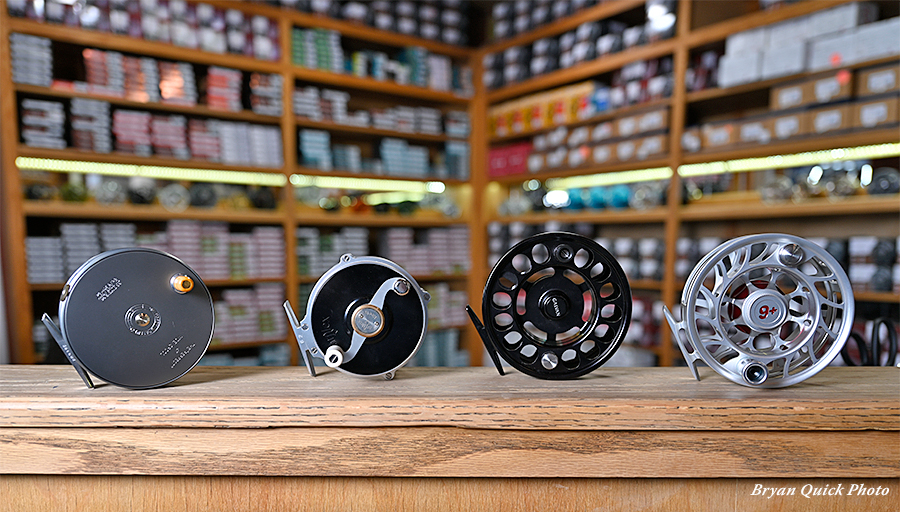
Assortment of fly fishing reels

Fly Reels:
This is where the arguments generally start and continue … Do you go with a traditional click and pawl, such as the Farlex or Hardy Perfect? Or do you go with something a bit newer with a full drag? There have been far more anadromous fish caught using a click and pawl reel than have been with a drag. From swinging flies for Atlantic salmon in the 1800’s ‘til the development of the stopping power of cork, Rulon, and graphite drag systems, a good drag is a real help when trying to land these powerful fish. But for aesthetics, nostalgia, and sound quality, many die-hard steelheaders prefer the older technology of a click and pawl.

2-Handed:

Single Handed:

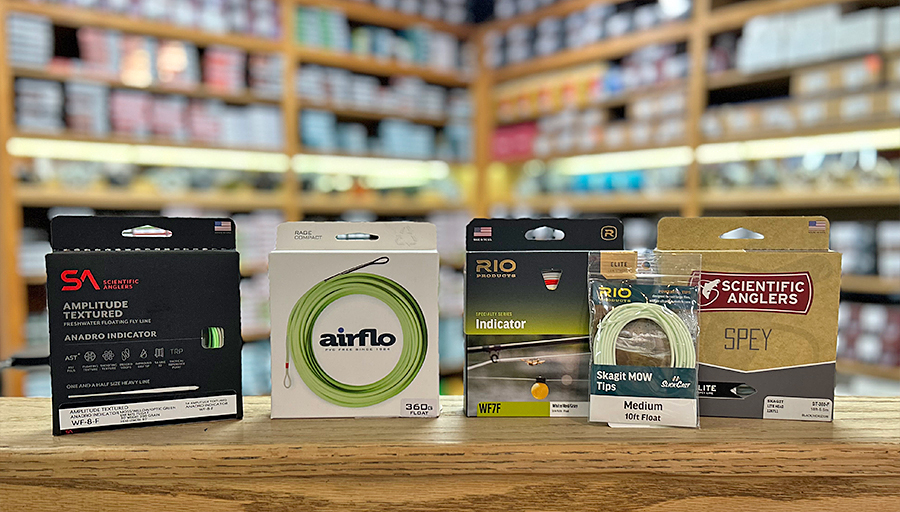
Assorted fly lines

Fly Lines:
Again, this one becomes a bit tricky depending on how you are going to be fishing for steelhead. It could also depend on where you are fishing. In the two-handed world, you will need two line systems – one for presenting a fly at or near the surface and one for getting deep. You will also need an array of sinking tips and leaders. For single-hand operations, a line with a longer head is preferred for mending during the drift or swing. Very few anglers swing flies on a single-hand rod these days. Those who do use an integrated shooting head with a sinking tip.

2-Handed: (From surface to deepest)

*Required Interchangeable Sink Tips for Skagit Heads
MOW T-14 Tips: 2.5’, 5’, 7.5’, 10’, 12.5’
A selection of 10 ft custom cut tips in different sink rates

Single Handed:

Assorted leaders and tippet

Leaders & Tippet:
Leaders and tippet are the last link in the chain between you and the fish of your dreams. Getting it right is critical for casting and presentation, while also being strong enough to handle a chrome missile. This is one item you will not want to skimp; it is arguably the weakest link in your connection to a fish. And given the time, effort, and expense you will expend chasing these fish, the few dollars you saved on tippet will provide no comfort as you reminisce about the fish that broke off.

Swinging:
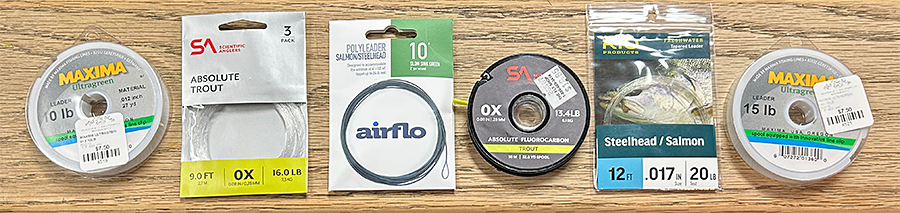
For summer steelhead fishing with Scandi lines, you will need a long-tapered leader off the end of your shooting head. The leader must be at least the length of your rod to properly anchor your D-loop to the river’s surface during the cast. Fine tune the length by adding 10lb. Maxima tippet.

For winter fish, we just use Maxima level tippet to make a cheap “leader” off the front of your sink tip. No tapered leaders are needed. Just loop to loop 4 – 5 feet of 15lb. Maxima onto your sink tip, tie a fly on the other end and let ‘er rip!

Single Handed:
If you are dead drifting nymphs, the easiest option is to use a 9ft. tapered leader in 0 -2 X. You use an indicator on this, or you can tight-line nymph. Or you can build yours right from the butt section to the first fly on your own. How, you might ask? Well, there are as many ways to skin this cat as there are guides and anglers. This would be a great topic for another blog post on its own. For swinging flies with a single-hand rod, the tapered leaders work very well. A 9ft. 2X leader will get the job done nicely.

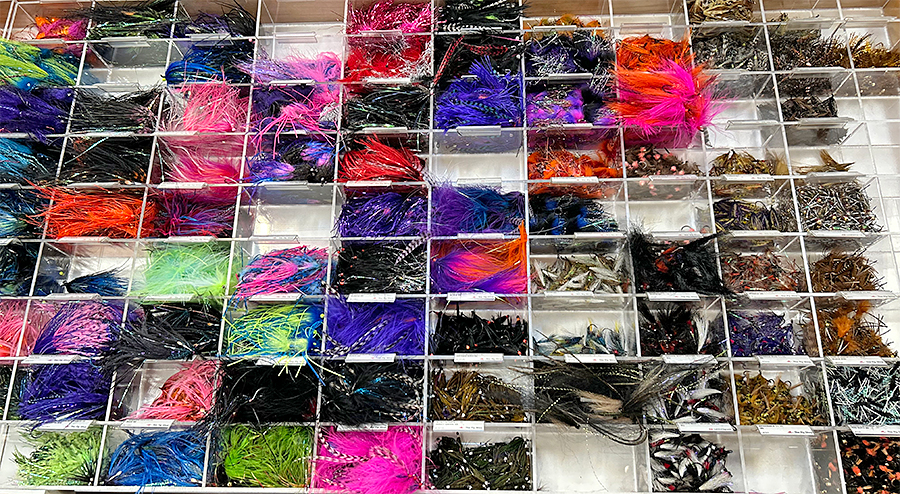
Assorted steelhead flies

Flies:
With the ability to fish with a single-hand or two-handed rod, the flies you use will depend on the style you are using.

Swinging:
Early season fish are super grabby and not too particular about what you put in front of them. Probably the most important thing is to get your fly in front of a steelhead. That said, the tried and true flies on the Trinity and Klamath Rivers are:

Later, when the water cools down and the fish are less likely to move to a fly, you will need something that will present a larger profile. Intruders in black and blue work great, but don’t pass up on pink and purple.

If you are looking for a challenge, try skating a fly on the surface. Early season fish are just as likely to chase down your fly on top as they are to eat a subsurface fly.

Under an Indicator:
When it comes to fishing for steelhead under an indicator it’s all about eggs. We’ll save the bead debate for another post. But, these little round balls of pink and orange produce takes. Around our home waters, stoneflies play a huge role in taking steelhead as well as small attractor nymphs like the Psycho Prince and Copper Johns in various colors.

Chris King teaching the 1-day Spey clinic on the Lower Sacramento River

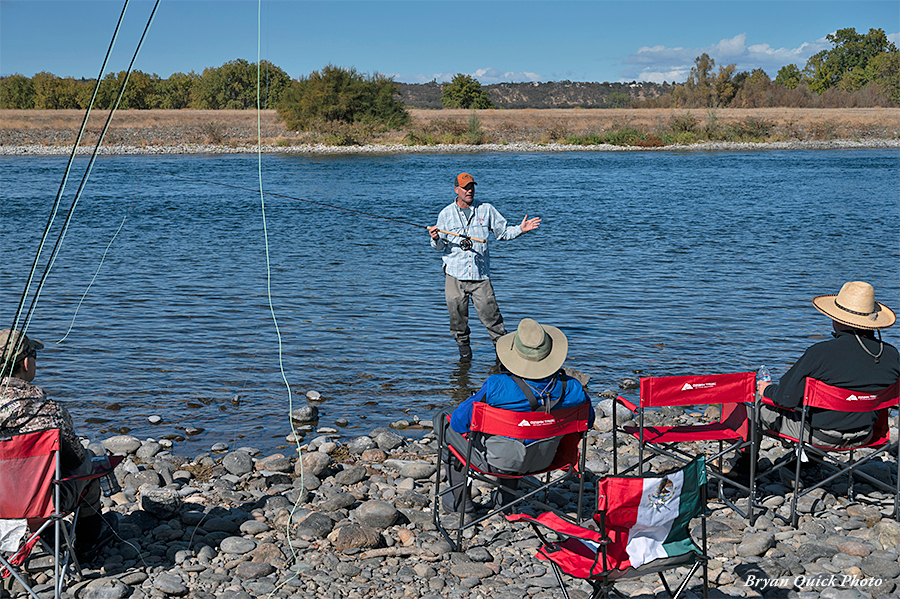
There are a lot of different methods to consider when chasing steelhead with a fly rod.  Maybe you’ve been thinking about giving two-handed fishing a try but just aren’t sure how to get started.  We got you covered. We will be holding our 1-Day Spey Casting Clinics this November (3rd & 4th) on the Lower Sacramento River just south of town.  Chris King, Master Certified Two Hand caster with the International Fly Fishing Federation, teaches these 1-day schools.  After either or both of these days with Chris you’ll be able to get out there and sling 2-handers with the best of them.

If you need to brush the rust of your double handed rod casting, these 1-day Spey clinics or a day on the water with one of our Swing Guides will get you back in the groove.

Clothing for Fall Fly Fishing

800 • 669 • 3474

“There is no such thing as bad weather, just bad gear…”

As the summer fades to autumn and the anticipation of cooler weather grows we need to change gears when it comes to our equipment and clothing. Fall is the best time of year for anyone who loves the outdoors; days begin to shorten, nights cool off, scarlet leaves blanket the forest floor and fishing waters start to cool. That doesn’t mean your fishing season is over, for a lot of us, it is just getting started. Many of us exchange our trout and bass rods for swing sticks and larger indicator rods. The two-hander that has been in your closet is anxiously awaiting making its first appearance in months.

It’s time to up your fishing game, lengthen your season, and we are here to help you dial it in.

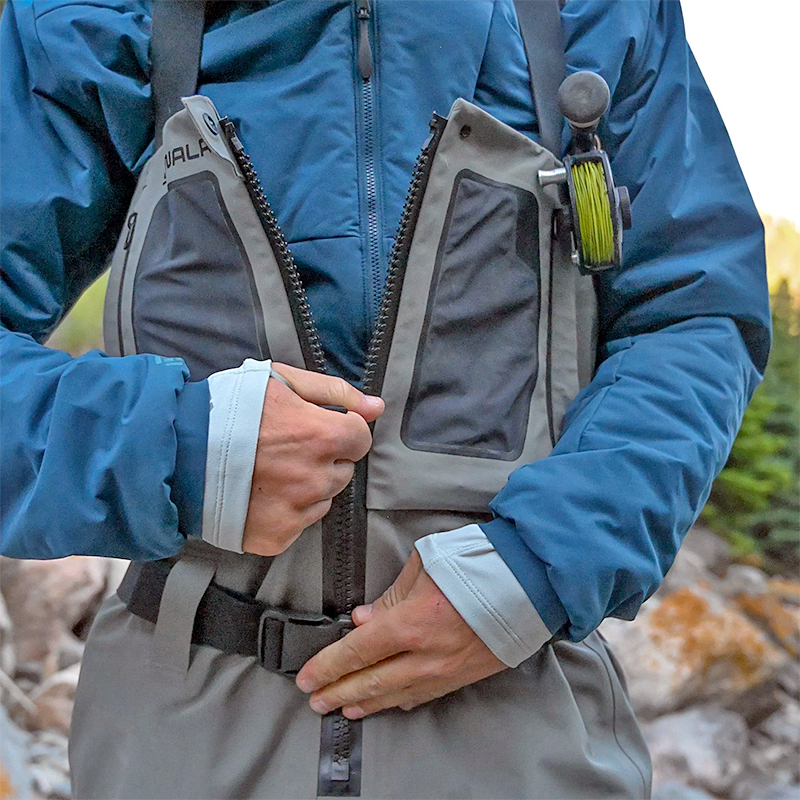
Skwala RS Wader being zipped upNeed a new pair of waders that better handle the colder temperatures?  Our go to for the fall are the Skwala RS Wader, Simms G4 Pro, and the Patagonia Swiftcurrent Expedition Wader.  As you can see, we chose zip front waders because when your hands are cold from a long day of fishing you want to make it as easy as possible to get out of your waders at the end of the day.  Just unzip the front and it’s easy to step out of your waders.  A great pair of waders can make or break a cold day on the river.  Having hand-warmer pockets and built-in drawstrings will help you stay warm even in the coldest of environments.
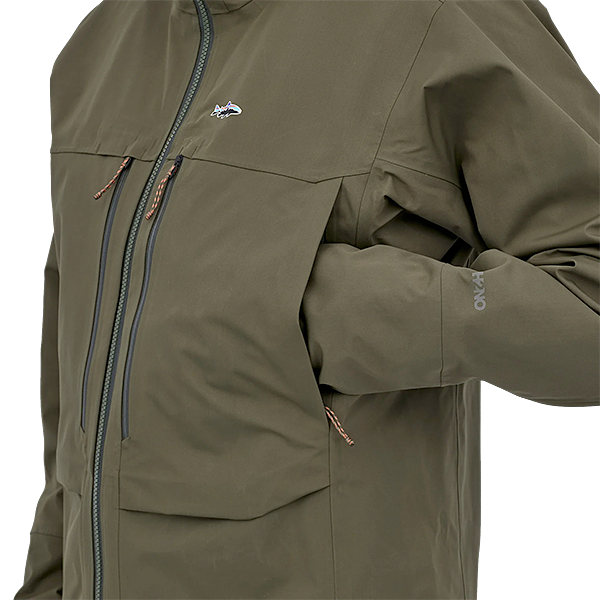
“I have to admit I loved the front zipper, a beefy YKK waterproof design. It was easy to use, had a nice T-handle and could be operated with one hand.”
Patrick Pendergast on the Skwala RS Wader

Patagonia Men's Swiftcurrent Wading JacketNow that you have a great pair of waders, maybe you already do, it’s time to talk about what you’ll be wearing up top to keep the snow and rain at bay. Fly fishing jackets have come a long way in the past 20 years. Less and less are you seeing the bulky things we used in the 90’s with bellow pockets and zippers hanging loosely.  We all remember filling those large front pockets with fly boxes and other gear, only to have our fly lines get snagged on overstuffed pockets and dangling zippers just as we are shooting out the perfect cast. The newest jackets are streamlined with hidden zippers, flatter pockets that have more purpose than just a junk drawer. Hoods are designed for better coverage and visibility.  You probably already have an old favorite in your closet, but maybe it’s time to upgrade. One quick question, when it is pouring and you’ve got your jacket zipped to your chin, are your shoulders feeling damp?  If so, then your jacket is probably in need of replacement. The DWR has worn off, the pores are filled with microscopic debris and that jacket is no longer doing its job. A few jackets that we highly recommend are the Skwala RS Jacket, Patagonia Swiftcurrent Jacket, and the Simms G4 Pro Jacket.  All of these jackets have great features and are the best of the best.

You are watertight at this point and the next question is, what are you wearing under your waders and jacket?  Just as important as your outer layers is what you are wearing next to your skin.  We strongly believe in the “layering system”:

  • Base Layer – Start off with a synthetic or Merino Wool fabric next to your skin. This often is a pair of thermal underwear (tops and bottoms) and they usually come in three weights: light, mid-weight and expedition or heavy. According to your individual metabolism, pick what is best for you. Synthetic and wool (non-cotton) materials retain little moisture and “wick” moisture away from your skin.  This is very important when you are hiking in waders or when outside temperatures heat up. We recommend the Patagonia Capilene Midweight top and bottom.
    • A small tip on the base layer.  You can also use your sun shirts as base layer tops.  They are lightweight and breathe well, so they make a great option.
  • Thermal Layer – Your second layer of insulation should match the weather and conditions you are being exposed to. Lightweight insulation for cool weather, mid-weight for colder conditions and heavy weight for really frigid days. Fleece is an outstanding choice here in tops and bottoms.  We suggest the Patagonia R1 top and R2 bottom. Or if it’s really chilly, a “puffy jacket” is a great choice, Patagonia’s Nano Puff® Hoody is our favorite.  A second option would be the Skwala Fusion 3/2 Puffy.
  • Waterproof Shell – The final layer on your upper body should be a rain jacket. High quality products are the best. Your rain jacket should be 100% waterproof and breathable, multi-layered, with sealed seams. Buy the best rain jacket you can afford, as it is one of the most important pieces of equipment you can own.

We’ve now covered the bulk of your clothing and waterproofing needs.  The only other items we would recommend are a comfortable, warm hat that will keep the heat generated from your head where it’s supposed to be, in your body.  Add a (toque) beanie hat and some great gloves to your arsenal and you’ll stay warm in even the worst conditions.

What other things could you possibly need to change seasons?  We’ve only really scratched the surface with layering and outerwear.  Of course, everything depends on what type of fishing you enjoy during this cooler season.  Here in NorCal the Fall means steelhead on the Trinity River, Klamath River, and coastal rivers.

There are a few pieces of gear that we would deem necessary to make your fishing more enjoyable and safer.

Angler walking with a wading staffNot everyone uses a wading staff, but more and more anglers have seen the light over the last few years.  Age isn’t the determining factor either, “I’m not old enough to need one of those things yet.”  Remember, this isn’t a walker or cane, but rather a great tool for walking and wading safely on uneven ground and on the slippery rocks in your favorite river or stream.  Don’t let pride ruin your day.  We recommend a wading staff that comes equipped with a belt holster and collapses into several pieces.  This helps to keep it out of your way when not needed.  Also, it should have a great retractor that keeps it within easy reach when you need it.  Taking a dunk in cold water is no fun and a wading staff is just the tool to help keep you upright.

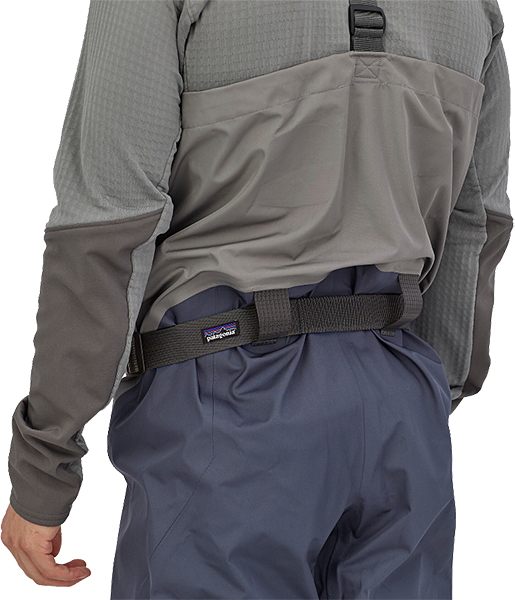
Patagonia Secure Stretch Wading BeltEvery pair of waders come equipped with a wading belt and there is a reason for that:  Safety.  These belts aren’t there to make your waders look good or to slim down your profile. Waders are generally built large in the mid section for ease of movement and layering. This same extra area that is great when dry is not so great when you fall in and water starts filling your waders.  Wading belts are there to slow the incoming water and hold it in the top portion of your waders until you are able to get back to shore and dry land.  If you are a wade angler, then you’ve most likely gone over your waders or taken a step into a deep hole that you didn’t see. This is when your wading belt comes into play.  Make sure you have one that fits properly – snug.  There are some great ones out right now with a bit of elastic in the back to stretch for ease of movement.  Some even help support your lower back.  We are happy to assist in your wading belt selection that will work perfectly for your individual needs.

We could ultimately go on-and-on with things to switch seasons, but we don’t want to overwhelm anyone.  If you have any questions on other gear that is needed to join in the Fall fly fishing game, we are happy to answer them.  Just shoot us an email or give us a call (800-669-3474) and we can talk you through every situation and what we would recommend.

We will be covering the essential gear (rods, reels, lines, flies, etc.) for fall and winter fly fishing in our next blog post.

In Memory Of John Dietz

800 • 669 • 3474

In Memory of John Dietz
(December 13, 1963 – July 27, 2023)
By Mike Mercer

I met John Dietz in 1978, shortly after I took the job at The Fly Shop®. I was 18, he was 15, and it turns out I had taken the job he was hoping for! We laughed about that off and on over the ensuing 45 years, as our friendship deepened and we shared a lot of life and rivers together. I stayed at The Fly Shop, and John’s enthusiasm for people and the fly fishing industry took him to the Rocky Mountains and a job as a rep of some of the largest fly fishing brands of the day. He learned the trade under the wing of one of the best in the business, Van Rollo, and eventually went out on his own. Those in the industry fortunate enough to have known John in those days will attest to his honesty, enthusiasm, and genuine desire to put the best products in the hands of fly shops and do everything in his power to help them be successful.

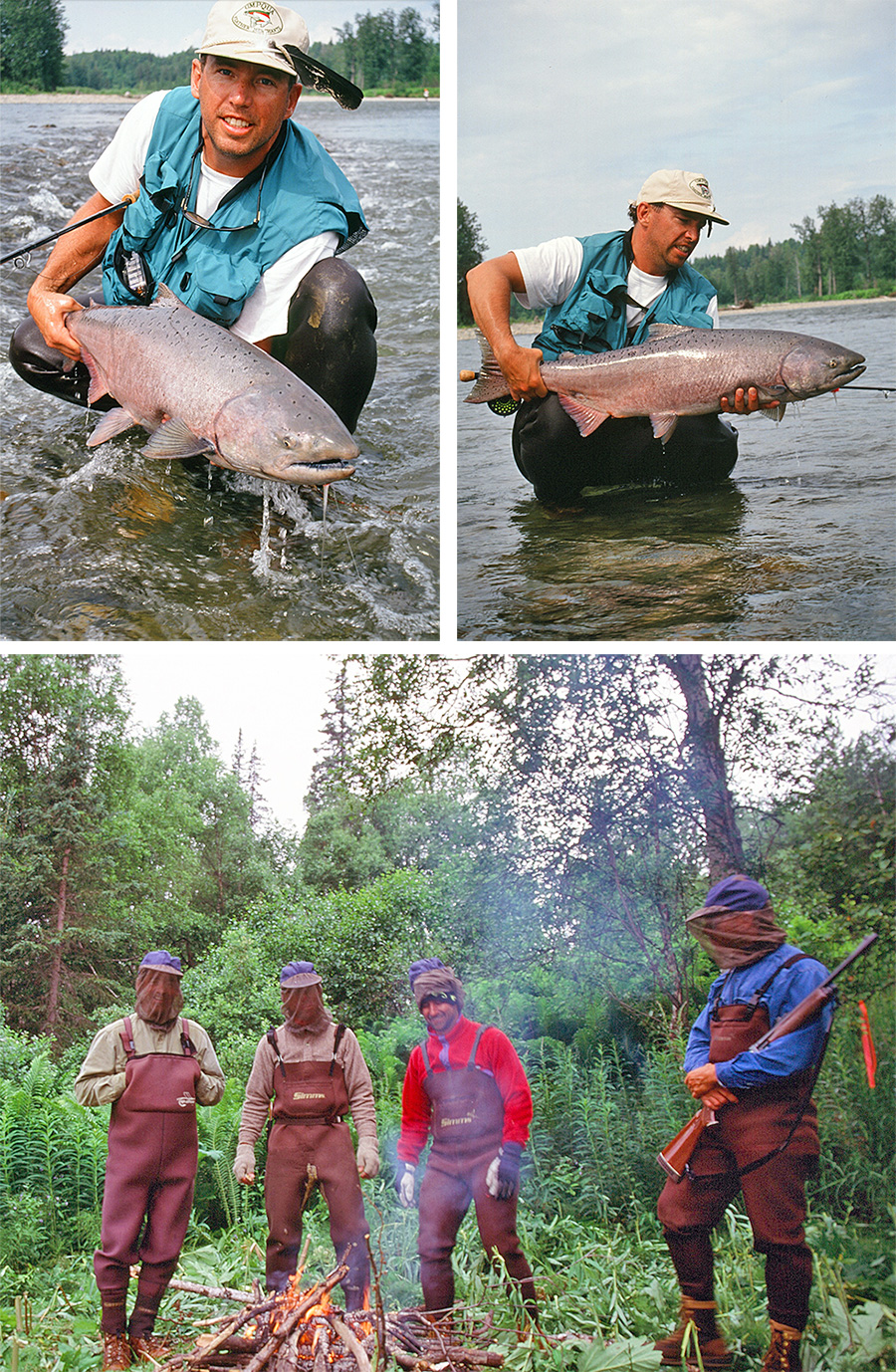
John Dietz in Alaska fishing for King Salmon

Eventually, health issues forced John to give up his beloved road work as a rep, and he went to work again at The Fly Shop, this time as a retail salesman. Over the past years John brought the same knowledge and enthusiasm to this job, and no-one took more pride and pleasure in taking care of our clients, whether it be a teenage kid with a few dollars in his pocket trying to start in the sport, or an experienced traveling angler needing help with a trip to some exotic fly fishing hinterland. Just ask anyone lucky enough to have crossed paths with him; they will describe how he always went the extra mile for them, how he always was patient and took however much time was needed even if it meant staying a little bit late…and how much John just obviously CARED about them.

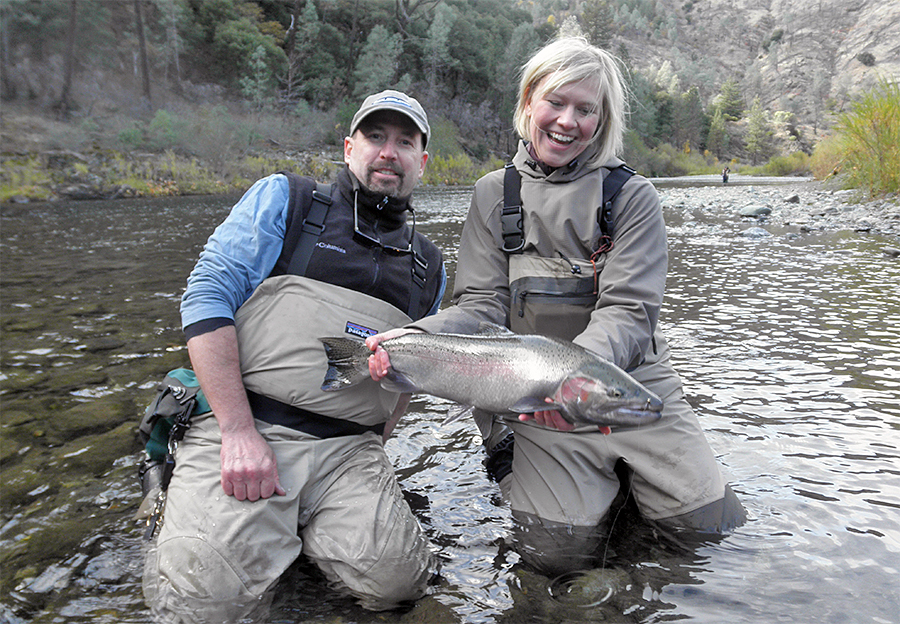
John Dietz with Kara Tripp on the Trinity River with a Steelhead

John dealt with serious heart issues nearly all his life, yet never allowed it to slow him down. When he was diagnosed with cancer a few years ago, right in the middle of the worst of Covid, he faced it head on, and continued to help others in every way possible. Eventually his health forced him to stop working at The Fly Shop, yet he continued to tie flies commercially for us…if you have fished the flats anywhere in the world over the past few years it is likely you cast some of John’s flies to tailing bones.

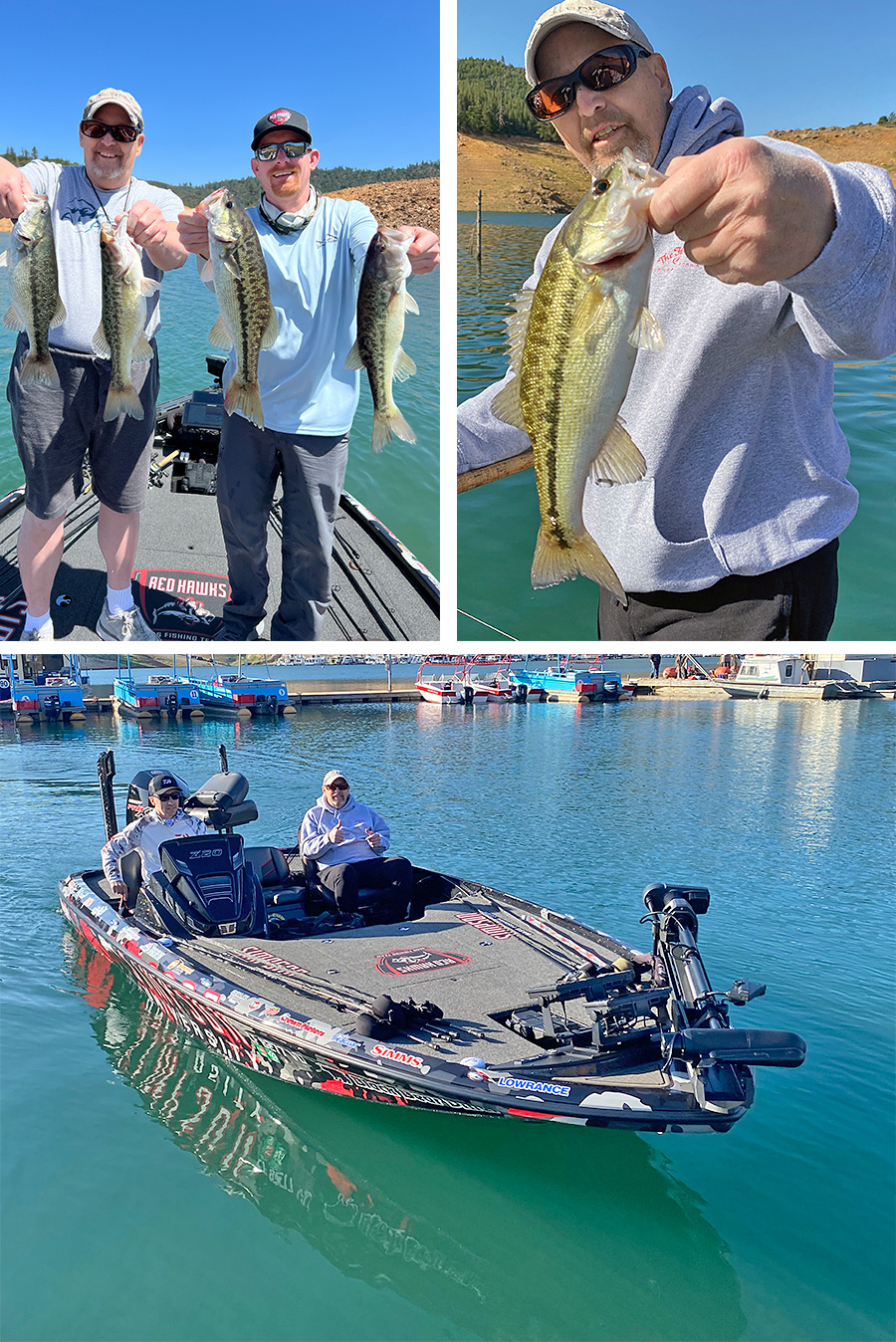
John Dietz with Zack Thurman doing some bass fishing

Recently, John suddenly and unexpectedly passed away. We are all going to miss his big heart, infectious laugh, and genuine desire to help others. He was one of my best friends for nearly 50 years, and a more loyal and dependable friend I cannot imagine. We shared more streams, laughs, and memories than can be imagined, and I will forever be grateful for him in my life.

Celebration of Life:
When: August 24th (9:00 am – 11:00 am)
Where: Anderson River Park Amphitheatre/Grass area

Gear Review: Scott Swing Fly Rods

800 • 669 • 3474

When you set out to chase migrating fish, you better be prepared for a whole lot of heartache with an occasional pulse of adrenaline. Any given day Mother Nature will throw nasty weather at you.  Your buddies told you where to go, but the fish moved 20 miles upriver overnight. When you choose to play this game there is no guarantee that the fish will even be there. So, your gear better show up.

The swing series from Scott does just that.  From Scandi lines to long bellies to heavy tips on the end of a Skagit head, these rods perform.  They’ll kick over a skater 100 feet out on a 20 foot leader and rip a 5 inch intruder out of the anchor and send it towards your target.

Zach Miller casting the new Scott Swing on the Trinity RiverSpey casting produces a fair amount of torque on the rod and Scott’s X-Core and Arc2 technologies really shine here and provide excellent directional stability. They feature progressive loading actions and fast recovery speeds. With components like titanium stripping guides and a completely redesigned aluminum reel seat that can accommodate both the new high tech reels and our beloved antiques, they feel incredibly light in the hand.
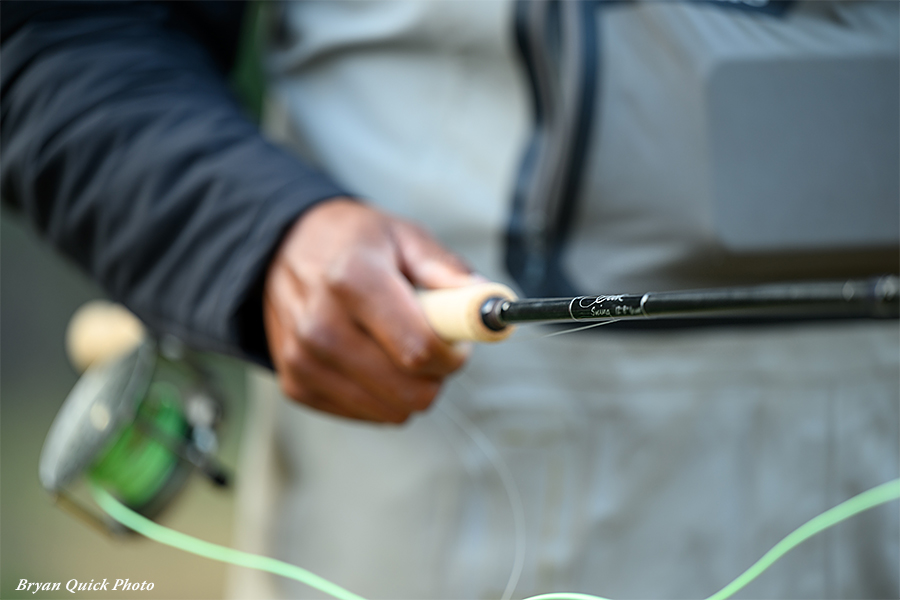
The 2 single hand rods in the series are a blast to fish. Equally comfortable with long belly lines and a bomber skating on the surface as they are with the shorter compact Skagit lines like the AirFlo Scout. These rods really bring us back to the glory days before the two-handers took over. If it’s been a while since you went out and had a single-hand swing day, give these beauties a wiggle.

Some of our favorites in the line up:

9’8” 8wt
This gem will huk a shooting head to the far bank overhead and excels at roll casting the same head in tight quarters. Take this one along with a 280 grain Scout head from Airflo on your next Silver salmon outing to Lava Creek Lodge, AK and you’ll put the hurt on ‘em.

11’ 8” 4wt
This rod is just magical with a 270 grain scandi line for skating dries for half-pounders. It performs equally as well with a 320 Skagit chasing trout with streamers and soft hackles.  This is our favorite on the Lower Sac for those evening caddis hatches.

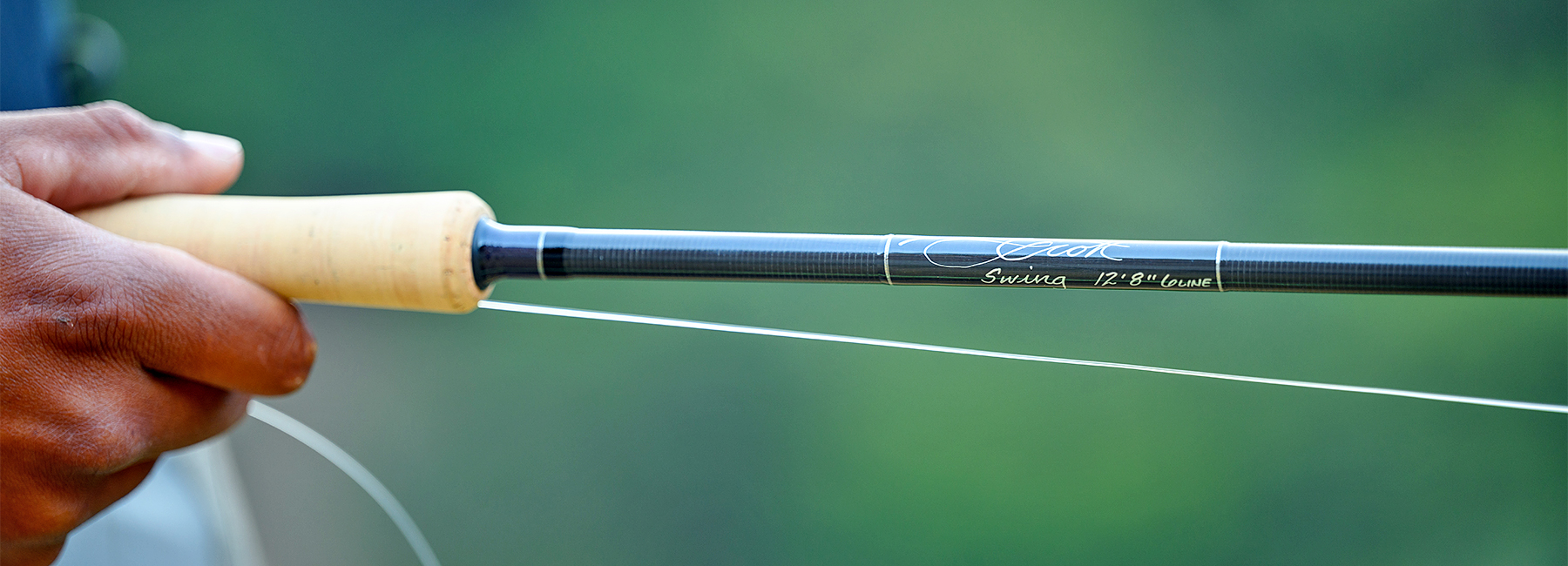
Holding the new 12'8" 6 weight Scott Swing

12” 8” 6wt
This is our Trinity / Klamath stick. Not too big for the half-pounders that show in the early season and just right for the 4-8 lb steelies that show up in the late fall. A great rod for on or near surface presentations with a 390 scandi or Rage head from Airflo and a wallet of Poly leaders.

12’ 8” 7wt
One of the best Spey rods ever built was the 12’8” 7wt ARC. This new model in the Swing series holds true to its roots with a length that is just perfect for Northern California and Oregon.  Short enough to maneuver down the trails lined with doug firs and long enough to handle extended line control when you punched it to the far side of the river. Faster than its earlier cousin with a great feel and exceptional control.  If you’re gonna buy one for NorCal / Oregon.  This is THE one.

13’ 8” 7wt
If you’re looking for a stick that is perfect for the big rivers on the coast, this beauty is perfect for long casts and open water. Wading deep on the giant gravel bars of the Pacific Northwest, this beast has plenty of length to help keep your D loop of the water and ready for launch. It likes grain weights in the 480 – 525 range and is ideal for long belly lines and exceptional line control for those super wide glides where the big boys sit.

14’ 1” 9wt
The Viking Stick – his is the Scandinavian rod that performs flawlessly for this technique.  With mid and long scandi style heads, this rod is capable of incredible line speeds and wicked long casts. Incredibly light in the hand for a rod of its size.  With the power of Thor’s hammer when it comes to turning the largest of Atlantic Salmon. With this rod, a scandi head in the 585 grain range, and a passport you are ready to conquer the world!

12’ 8” 10wt
The King Slayer – the ultimate power stick.  Take this one with you when you are targeting the largest salmon on the planet. Tidewater kings are no match for this boomstick. Keeping the length under 13’ helps with being in contact with all things Skagit.  It will turn over the heaviest of tips and the largest of flies.  When you have to go deep and need the power to turn true monsters, The King Slayer fits the bill.

If you’d like to look at the entire lineup or purchase a new Scott Swing Rod, follow this link:  https://catalog.theflyshop.com/scott-swing-fly-rods/