Trout Fishing in the Jungle
I just recently returned from 23 days in the Brazilian jungle. The typical questions I get when I mention jungle fishing are usually about all the things that can bite, sting, kill, and eat you: anacondas, candiru (the fish that swims up your junk), killer bees, man-eating jaguars, poison dart frogs, poisonous spiders and snakes, caiman, piranha, tarantulas, scorpions, mosquito-borne diseases… I’ve been asked about all of these, and more!
Some are legit, while others are myths, urban legend, extremely rare, or just the usual gossip that people love to spread and be scared of. We all love to be afraid. There are destination specialists in my office afraid of the jungle. It is no different than all the bear stories in Alaska. I guided for 15 summers up north in Alaska and Kamchatka and saw thousands of bears and had some very close to me on many different occasions. On one occasion, I could have taken one step and tapped a bear on the head as I woke him up from his salmon-induced slumber. Can bears eat you? Yes! Does it happen? Pretty unlikely.
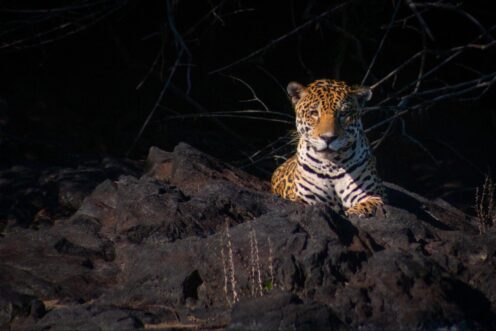
Can you encounter any of these things in the jungle? Of course. But in certain areas, it is a lot more common if you are partaking in certain activities that you probably shouldn’t be doing in the first place. If you are roaming through the jungle alone, lifting up logs, and scrambling through thick brush along some backwater, stagnant lagoon, then you are a lot more likely to have close encounters with snakes, spiders, possibly a hornet’s nest, mosquitoes, and maybe even get eaten by a jaguar. However, on fly fishing trips, you are on the river, mostly on a boat, and with experienced guides and local natives. This is their happy place and their neighborhood. Not many bugs and pretty darn safe.
Mosquito-borne illnesses are real and something to be aware of, but most of the fishing in the jungle coincides with the dry season and low water, so not many mosquitoes. Many of our fisheries are black/tannic water and some are very clear, which isn’t great for mosquitoes either. Spending most of your time on the open water reduces encounters even more. I can probably count the number of mosquitoes I saw on two hands during my entire 23 days of fishing.
I didn’t see the jungle as 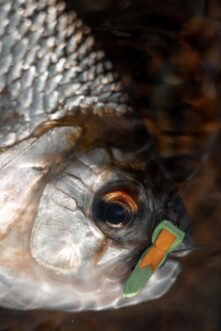 ominous, scary, and dangerous. I saw it as alive and rich, full of life, and lots of fish that are fun to catch and in many ways reminded me of fishing that I have experienced in the past.
What was even cooler about one of the locations I fished was how familiar the fishing was and how much it reminded me of trout fishing. Like many people, I started my fly fishing journey with trout. For me it was Montana, as a teenager. Trout are such an ideal fish to pursue on a fly rod and very accessible to us here in the U.S. They readily eat dry flies, nymphs, and streamers, they live in pretty places, and they are quite feisty when hooked. These styles of fishing are what most of us are familiar with. I will always have a soft spot in my heart for fishing an open, crystal-clear river and watching a trout sip my dry fly off the surface, or throwing streamers along cutbanks for wary browns looking for a big meal.
Kendjam Lodge
Kendjam Lodge is located in the southeastern region of the Amazon Basin in north-central Brazil. It is one of those fisheries, like Mongolia, where you go for the fishing but come back with so much more. The landscape, the Kayapo native people and guides, the river, the adventure of getting there, the abundance of bird life along the river, and all the different species of fish and styles of fishing.
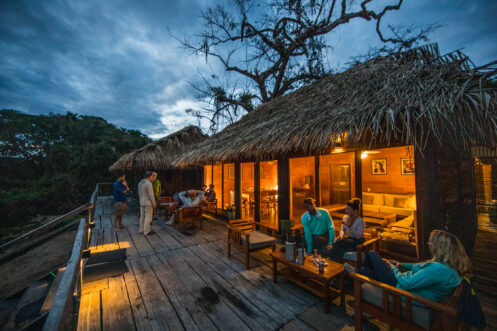
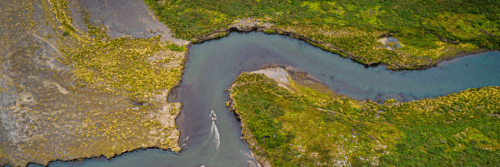
It sits on the Iriri River, which is absolutely beautiful. A big, crystal-clear river that breaks up into smaller channels and braids with a granite rock bottom, featuring different-sized boulders, rocks, and sand, as well as some big shallow sandbars and rocky or sandy flats. There are large slow-water sections that look like small lakes, fast-water areas with pools and runs, big wide flats, and even some pretty good-sized rapids. Big granite boulders, some as big as houses, are stacked on top of each other in some sections. It is a very fish-rich river.
As you float over the pools and flats, there are fish everywhere darting away from the boat. It is unique for the jungle and not something that you would expect. Lots of species of fish to catch and lots of ways to catch them, all using floating lines.
When floating, the guides kept us 40 to 50 feet off the bank as we fired streamers to rock edges, submerged boulders, and overhanging trees. Peacock bass would dart out of nowhere, sometimes in pairs, to chase down and inhale our little baitfish imitations. You can’t strip fast enough. It was amazing to see bicudas come from behind submerged rocks in the swift current, so fast that it was startling that something was moving that fast in the river, then hooking them and holding on as they torpedoed out of the water, splashing down and immediately ripping out line. This was so similar to fishing a big western river with a drift boat, pounding the banks with streamers for big browns.
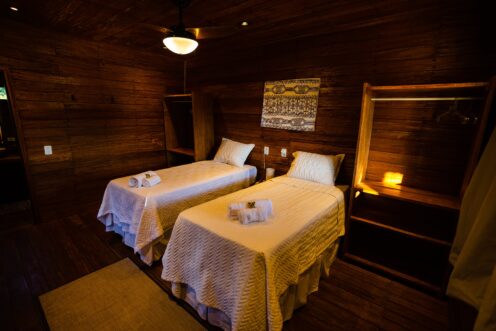
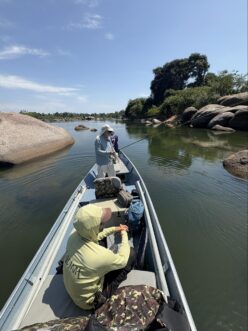
Even more unique was the dry fly fishing we experienced. The second day I was there, our guide brought us to a big open flat with soft, even current, and depths between two and four feet. One of those spots where you jump into the water and the current on your legs is gentle and just feels right for a fish to lay in.
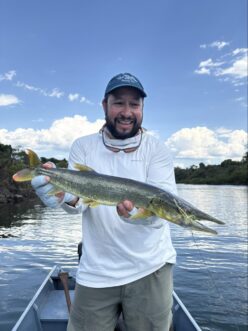
You could see shiny, metallic flashes of matrinxã and pacu (three species) as they moved on the bottom of the river, fish that were nervous of movement and shadows. I put on a #8 peacock Chubby Chernobyl with a small olive woolly bugger dropper, tossed out a cast, and stack-mended the line for a long, downriver dead drift. On the second cast, I saw a silver shimmer and my Chubby went under.
I set the hook and a matrinxã came out of the water, landed, and made a good run across the river only to come back to the middle of the flat. It pulled like crazy and was very hard to move. After a few minutes and a
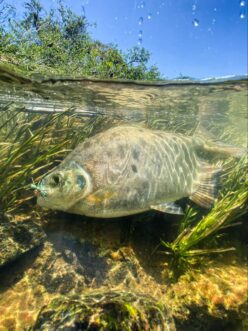
great fight, I landed the fish. What a cool species. They eat streamers, dries, and nymphs, jump, and are super scrappy. Big silvery scales, black tail, a smaller mouth, and of course teeth. Everything in the jungle has teeth. Their body resembles a shad but taller, which adds more pull to the fight. I spent the next hour hooking 8 to 10 of them, almost all on dries, as I ended up taking the dropper off. I lost quite a few when they bit through the line.
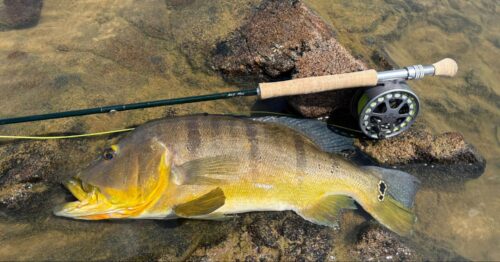
A couple of days later, we fished for them again below the lodge. This time they were stacked in the shade beneath overhanging trees. You could see them moving in the shadows, feeding on baitfish or anything else that fell in the water. I used a Gypsy King, thinking the longer shank would reduce them biting through the leader. I fished a dry fly only, no dropper, and when I could get a cast close to the trees or in the shade, I got a take.
Some were sipped while other grabs were more explosive, the fly attacked as soon as it hit the water. It was like drifting a hopper on the edge of willows in Montana for a fat brown laying in the shade, but there were schools of the matrinxã on this river. I probably landed six or eight but still broke a few off. The longer shank hook was definitely better.
On the last day, Ciru, one of the guides, showed me the best rig of a very short piece of wire on the end tied directly to the fly. I know, fishing dries with wire, but it worked great. It’s the jungle.
I would go back to Kendjam in a second and bring a more comprehensive box of dries and nymphs and fish more for the matrinxã and try for more pacu. We only scratched the surface of the dry-dropper fishing while I was there, as we mostly fished for peacock bass, bicuda, and in backwaters for wolffish.
Seasons
The fishing season at Kendjam is relatively short from mid-June through the end of August – the dry season in the Iriri Basin. Space is limited, early reservations are strongly suggested.
What kind of angler would enjoy Kendjam?
Kendjam is perfect for anybody with a little sense of adventure. Those looking for something exotic and who love to pull streamers and dry fly fish should seriously check this place out. Don’t let the jungle scare you. Grab your favorite 7-weight streamer rod and a 5-weight for dries – the fishing will be a lot more familiar than you think. Trout fishing in the jungle.
Erik Argotti
The Fly Shop®
Destination Specialist
argotti@theflyshop.com | (530) 222-3555 | (800) 669-3474
Erik Argotti has spent his entire adult life guiding and chasing trout, salmon and steelhead in far off places around the globe. He spent 15 seasons guiding in Alaska and Kamchatka, Russia, and a few winters guiding in Argentina at Estancia Laguna Verde – Strobel (Jurassic) Lake. When he wasn’t guiding, he spent months traveling and exploring rivers and lakes in New Zealand, Alaska, Argentina, British Columbia and Montana. His newest angling-travel passion is exploring and fishing jungle destinations in Africa, Colombia and Brazil and he is one of the nicest and most patient guys you could spend a day in the field with.